Showing posts with label agriculture. Show all posts

Monday, August 14, 2017

Mid-America Show 43

Time again for the visit to the Mid-America Threshing and Antique Show.  This is the 43rd annual edition.  This year's featured machinery is by Allis-Chalmers.

Allis-Chalmers Company was formed in 1901 by the merging of the Edward P. Allis Company, manufacturer of steam engines and mining equipment, with Fraser and Chalmers, makers of mining equipment, along with Dickson Manufacturing Co. and Gates Iron Works.  They currently manufacture farm equipment, heavy construction equipment, generators and engines, stuff marketed worldwide.


Really old.
 
Not quite so old, but restored.
Besides A-C, there were many other marques represented.
These labels were on the tractor below.


And what's this?  My guess: Someone loves his wife or his daughter, or someone loves herself more than they love the tractor.  Nicely restored machine, though.

I have attended many editions of the MTA show here in Tipton.  But then it is close by.

2010

 2013 

2013


Wednesday, July 20, 2016

Fair Time, '16

Hey, Ma, wanna go to the fair?

Sure, but we'll have to put on shoes.


 Plev-nee, Ma, Plev-nee

 Judgin' the livestock, Pa.

 BBBH always heads to the goats.

 JoLynn thinks this fella got gypped out of his ears.

 Er-a-er-er! These guys were loud!

Tipton's new approach to waste disposal.
I may have more to say about this later.

And that is our visit to the fair, 2016.

Friday, July 17, 2015

Weather Whether or Not

Three years ago today I posted an article entitled "Hot Enough For Ya?" in which, I am sorry to say, I came close to carping about the weather.*  Today's post may approach that level of thinking as well.

I have lost track though I am sure the weather bureau could tell me, of the number of days in which we have had significant rainfall.  I stopped counting a couple of weeks ago at 41 consecutive.  I am quite certain that we have had in excess of 16 inches of rainfall since the first of June.  We have now had two glorious days without precip!  But it is scheduled to be back soon, along with temps that will rival those of the summer of  '12 about which I came close to carping.

A walk in the meadow in the evening or a bicycle ride along the streets in the morning, the pleasure of either is diminished somewhat by the foetid aroma of the decaying vegetation which has lain too long under water.

A week ago Purdue agronomists had estimated crop losses in the state at over 430 million dollars.  I did not get this week's report.  Like it or hate it, the weather is a big deal, and we do not control it.

*Complaining about summer heat is a violation of my policy whereby I try to confine my gripes to the winter weather, which I hate

Saturday, May 16, 2015

Groundsel

For years, I have seen the yellow fields in Springtime Indiana.  Being basically ignorant of botany and agriculture, I mistakenly assumed that the plants were mustard, and in some instances even imagined that they were literal rape (canola) crops.

Today I took the time to walk into a field and pluck a sample of this creature for closer study.  Imagine my surprise when at first look I saw not a blossom with four petals, but rather an aster-like cluster of flowers on each stalk.  To the interwebz!  A Purdue University site quickly made identification certain: Butterweed or Cressleaf Groundsel (Packera glabella formerly Senecio glabellus).

It’s everywhere!  It’s everywhere!

Look at that little dickens.  Would you look at that?


Thursday, April 9, 2015

Green!


During our evening walk, I had been thinking "A week into April and the trees are not showing green.  What's the deal, anyway?"

We turned the corner to head across the field back toward the house.  I could see our row of austrees ahead, and against the grey of the evening sky, green!
Ever so subtle, but the trees are showing green.


Soon the neighbors will drill in the corn, the beans, and life's productive season will begin!
Renewal.


Saturday, October 25, 2014

Old Silos

 Sharkbytes discovered a very interesting steel silo which she shared with us here.  

There is a wonderful old vitrified tile silo four miles from our house.  It is all that remains of an abandoned barn lot. The silo sits on the boundary between a soybean field and an old woods.

We drive by this location often, and BBBH and I have had some interesting conversations about a dream of building a home on this spot and incorporating the silo into our new digs.  I'll not rehearse the silliness of our "plans" but I will say that we have come up with some great ideas!

Less than a mile due south of the tile structure is the farm of a dear friend of ours.  This old banded stave silo sits about an hundred yards from the house.  There are numerous modern structures between the house and the silo.  I am sure that Little Jo Ann could have told us the history of this silo, but she passed away this summer.  As many times as we visited this farm, it never occurred to me to ask about that.

Go visit Sharkey's silo.

(Apologies for the photography.  These pictures were taken within five minutes of each other, but I had to shoot into the sun on the first one.)

Tuesday, September 30, 2014

Plentiful Harvest

The perfect fall afternoon, blue skies, eighty degrees, scooter ride.

The wagons of shelled corn on the way to the elevators told us that harvest was underway.  The fields gave testimony to that fact.


This beanfield is not quite ready to cut, but we saw several that were.

These tractors are resting from their hay-making chores.  The product is mowed, fuffled, and raked.  Soon it will be baled.

Hay that is baled for market is usually baled in rectangular bales, but most people who plan to use the product locally bale in round bales.  Depending on size and density of product, a round bale will weigh anywhere from 700 pounds to 1800 pounds.  They are handled with tine attachments on the tractor.


The last of the Uncle Jeptha Tales
appeared here on September 25.    
Should you wish to read or reread 
any of them, They can be accessed 
via the “Short Stories” and “More 
Stories” tabs at the top of the   
page.                              

Wednesday, September 24, 2014

Another Did That

I posted this article a couple years ago under the title "Jurisprudence Trumps Science." The thing that motivated me to look it up and drag it forward was this. We finished the garden tomatoes at supper. Beautiful golden and red slicers, so tomatolicious. Summer time gives me the opportunity on occasion to toss in this little tidbit for the edification of the auditors. And 121 years later, it seems yet that suing the government is a zero-sum activity. The plaintiff is likely to get zero, and the cost to the defendant will likely be zero. The attys win, though.


Jurisprudence Trumps Science

On May 10, 1893, the Supreme Court of the United States upheld a lower court decision and declared the tomato to be a vegetable, not a fruit.

 Notwithstanding testimony to the contrary, and much reading from dictionaries by both parties to the dispute, ultimately Justice Horace Gray wrote the opinion for the court in which he essentially said that notwithstanding that all botanical references did seem to support its status as a fruit, because of its historical place on the dinner-table,  eaten with the main course, not as a dessert, the tomato is a vegetable.   

Some background might shed some light on this astounding turn of events. Under the Tariff Act of 1883, fruit were admitted duty free, whereas vegetables were not. The plaintiff had been paying, under protest, tariff on tomatoes and was therefore suing to recover said payments from the Collector of the Port of New York and to require such collections to cease.

 Does it take a genius to figure out what is about to go down? Merchant vs. Government of the United States, essentially, though that is not the name of the case. What duly appointed and honest justice is going to rule contrary to the interpretation of the government?  If the government says the tomato is a vegetable, the tomato is a vegetable. Case closed.

Case is Nix vs. Hedden, 1893.
Image:  The Kitchen Table

Sunday, November 3, 2013

Arkansas River Valley #T

A number of the tales as told by Uncle Jep and presented here are set in the Arkansas Valley of Southeastern Colorado.  It was in this region that I was born during the Dust Bowl days of the "Dirty Thirties."  I did not grow up in the area, yet I was never far from it, and there has always been an affinity between me and the land, the countryside and the small towns that dot the Valley.

I do not profess to have special knowledge of the area, but I grew up hearing stories of the old days along the river; dry-land farming, windstorms; irrigation and water wars.  And thus it is that while the tales being presented are strictly fictional, figments of my imagination, they contain elements that bear similarities to life as it was lived.  There is truth in fact, and there is truth in fiction.

The West may have been won with six-guns and carbines, but the prize without water is not worth the taking.  Ergo, water disputes, rights and acquisition thereof, have been part and parcel of much of the West since the beginning of the conquest.  The waters of the Arkansas rise in the high Rockies of Central Colorado and as the Spring melt of winter snows heads eastward, the great river carries potential for human  settlement and agriculture.  Where there is water, there are conflicting claims.  Disputes over water rights have jammed the court system from the beginning, and I daresay that if one were to pursue it, he would find that there are pending cases and cases in progress related to Arkansas Valley water rights to this very hour. Dry-land farming has been practiced with greater and lesser success from year to year in Southeastern Colorado since the first settlers arrived.  But near the river, irrigation has been practiced since the first ditch was dug to divert water onto farmland.

In the latter quarter of the nineteenth century, sugar beets were introduced into this country, and two areas of Colorado were found to be ideal for this crop when water was available.  According to The American Sugar Beet Growers' Association, the first sugar factory for processing beets  in the United States was erected in 1879.  By 1917 there were 91 such plants in 18 states from Michigan to California.  The Arkansas River Valley was prime land, and there was river water to be had.  Many little towns, including Holly, Swink, and Hartman where I was born, had mills pouring out sugar for the market by the carload.  "Dirty, ugly roots in one end, sparkling white crystalline sweetness out the other."  What a deal!  The beet growers were blessed, too, in that, unlike cane which required a "double processing," beet sugar could be obtained in a single process.


Image: sciencedaily.com

But there was the water issue.  By 1893 the Amity Canal Company had filed for water rights.  A few years later Holbrook was granted rights.  There arose a dispute in which Holbrook claimed that by taking full draw on their rights Amity was depriving Holbrook of its grant.

To Law!  Bring on the lawyers, get to court.  In 1920 or '21, Holbrook sued Amity in Circuit Court.  Amity successfully defended its position and in 1921 the court so declared.  But that is not the end of it.  It never is.  In 1929 Holbrook filed in District Court and the matter was heard yet again, and again Amity prevailed.  It went to Appellate Court in 1931.  Amity prevailed.*

Or should I say, the lawyers won.  They always do, no matter how the court rules.

*Information extracted from leagle.com.

Jesus answered and said unto her, Whosoever drinketh of this water shall thirst again: but whosoever drinketh of the water that I shall give him shall never thirst; but the water that I shall give him shall be in him a well of water springing up into everlasting life. John 4:13,14 (KJV)


Thursday, October 10, 2013

Pipe Wrench and Bad Words #T

Did I tell ye about the time your grandpa an' me was takin' out the old windmill?  We was livin' there on the high plains, and generly we'd a just left it, but times was hard and anything ya could salvage was a nickel in your pocket.  Arly Page, he was your grandma's cousin, he even saved the asphalt shingles offa his shack in Holly.  Carted 'em all the way to Canon when he moved up there.  His wife, Irene, come from over thataway, you know, and she'd have it no other way but she was goin' back where her mama was, Arly or no Arly.  Well, you know Arly, and besides they had them twins, dickens of a pair, they was; but Arly couldn't bear to be apart from 'em, so they moved over to Florence and Arly built 'em another shack.  Them twins even straightened  nails from the old one to put up the new one.  Sally, she was the purty one a them two, she later married Wes Turpin, had the Ford franchise over to Pueblo.

So Sam, that's your grandpa-- I swear I gotta call him Sam, you know I mean your grandpa.  But speakin' of swearin', there was no way on this Earth Sam was ever gonna be heard to swear.  Sign of a weak mind, he always said.  So anyway, Sam had aholt of an ell on a two-inch horizontal pipe, hopin' to break it loose.  He give a mighty heave upward on the handle a that pipe wrench and the pipe broke!  That handle come right up, well not meanin' to be indelicate nor anything, but it caught him right where a man least wants to be hit.  Sam turn loose a that wrench and doubled over like a jackknife closin' on its blades.  Shoulda heard him groan.  When he finely can speak, he says, (I think), "Oooh, gonies."  But he never cussed.  Not one cuss word outa his mouth.  I told you Sam didn't abide swearin'.  Ho!  Not like Preacher Redkin over to Swamp Lick.  Man, could that guy cuss!  String out a swear two minutes long, never repeat a word.  He warn't really a preacher, you know, but everybody called him Preacher on account of his ability to misuse the Lord's name in so many unique and creative ways.  So then Sam picks up his wrench, straightens up, and says, "Could ya put your wrench on that hunk a busted pipe so's I kin get this ell offa here?"

So then we drove the new well and hooked 'er up.  Fred Slocum over't the hardware says to Sam one day, "Sam, where'd ya get your parts for that new mill-- ain't seen you buy nothin' in here but horehound drops in a coon's age."  Aside from Sam, the only person I know to forever be suckin' on one a them drops is your Aunt Jean.  But she's not had a tooth in her head in thirty year.  Her son, Jack, you know Jack, married Evie Tidler.  Married her on Christmas Eve, and they got snowed in in their cabin for six days.  "Didn't you dang near starve, Jack?"  Uncle Milt asked him.  "Who cares?" said Jack.  Evie give Jack twins middle the next September.  Twins do seem to run in the fambly.

So Sam said, "Salvaged 'em or made 'em.  Hada pay your prices, I'd be a old man afore I had a well.  Cattle'd die.  Gimmee two penny wortha them horehound drops.  Please."

© 2013 David W. Lacy

Friday, August 30, 2013

History and Agriculture

 We have passed this marker literally dozens of times.  Time to scrutinize it with more care.

 Seems that June 3 is the appropriate time to observe the anniversary of the organization of the county, so herewith we will remark the organization of Tipton County.
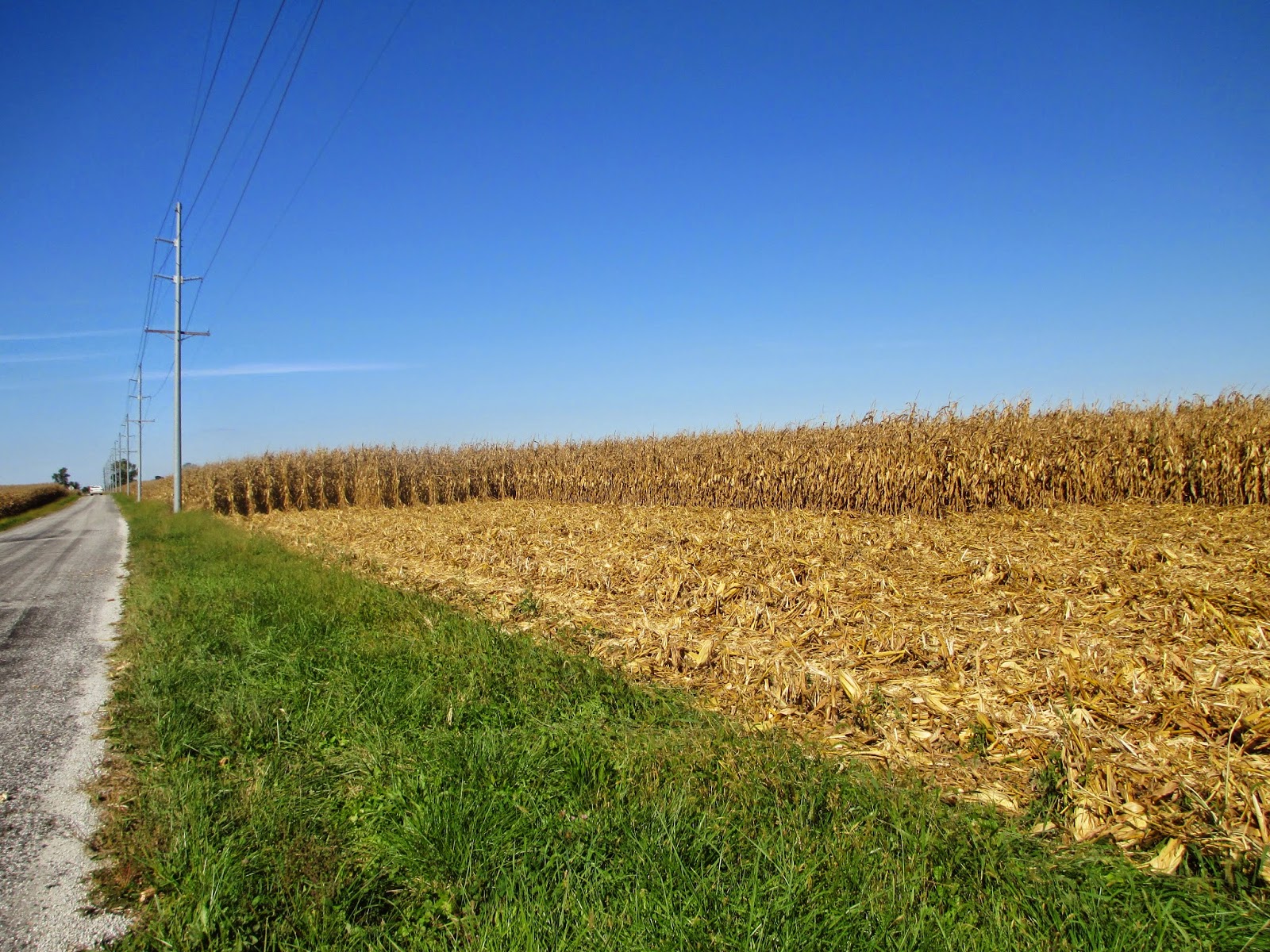
Our spin on the scooter took us through miles of corn and soybean fields.  The browning at the base of the plants is evidence of a soon-coming fall.  This field is quite typical of the corn in the area.  The tip of the fingers on my right hand is seven feet, eight inches from the ground.

Thursday, July 26, 2012

Detasseling

I was working in the yard along the edge of the street, trying to make the place look like someone lives here in spite of the devastation to the premises wreaked by the lousy heat and drought.  I looked up to see a young lad, early teens, walking up the street  with his bandana around his neck, his lunchbox dangling from his left hand.

"Hi," I greeted him.  "Detasseling over for the day?"  "Yes," he said, "thank goodness."

A brief encounter, but as he ambled slowly on up the street, a flood of memories overwhelmed me.  Our county grows lots of corn, lots of corn.  For many years several major seed companies have produced thousands of acres of hybrid seed corn here every year.  This has, for this community, provided short-term summer employment for lots of people, including children as young as fourteen.
It is hard, miserable, grueling work.  I am not speaking from hearsay evidence.  My own children had their turns in the corn fields.  But that would be hearsay if their accounts were placed in evidence.  Many of my junior high students as well as high school students were engaged in the enterprise.

And so this happened about 1974.  The high school principal, the middle school principal, and I decided to contract a small plot so that we could gain personal experience, so that we might better understand the situation the children were dealing with, and coincidentally so that we might pick up a little extra cash for ourselves.  This would be a snap.  Only eight acres.


Dawn came, we met at the field, long sleeve shirts, long pants.  Straw hat, bandana.  Galoshes, because it had rained most of the night.  The corn was wet, soaking us thoroughly.  The leaves are sharp and walking between the narrow rows was quite unpleasant.  The mud sucked at our feet on each step.  The corn was too tall, making for a stretch to pull the tassels.  By noon, the temperature was in the nineties.  We knocked off at one and went home, only to meet in the field again at sundown to utilize daylight until it was gone.  We should have been half-finished by the time we went home for the night.  We weren't.

Daybreak.  Back at it.  By noon, the inspector was breathing down our necks.  The field is "too hot."  You've got to finish this, like yesterday!  We took our afternoon break and recruited three of our kids and one of their friends, teens, to help us.  At standard rates times four, there goes a good chunk of our future walking-around money.  But that afternoon, the company moved in with a whip detasseler, which was a pretty new and untried technology.  This went ahead of us and whacked tassels to kingdom come, but it missed many of them and left us to clean up after the machine.  And we had to pay the cost of the machine and its operator.

Another day finished the job.  The galoshes are still somewhere in that field, what little dribby-drab of money we had left after the cost of the machinery and the kids was soon gone.  But we had the detasseling experience!


I have had many other experiences with the task, both directly and tangentially, but you've probably enjoyed about all of this you can stand.