Joash the Abiezrite had a son whom he named Gideon "Destroyer" or he who bruises and breaks. I think of him as The Hammer. The Midianites were a scourge to the people, destroying their crops and means of livelihood. The Lord revealed to Gideon that the people had strayed from His ways and their worship of Baal was the reason for their suffering. Gideon tore down his father's altar to Baal, cut down the grove, built an altar to Yahweh and sacrificed thereon.
Upon discovering the destruction of the grove and the altar of Baal the people were wroth and demanded Gideon's life. But Joash said, "What? If Baal is god, then let him fight his own battles." So he gave his son a new name, Zerubbaal "He Against Whom Baal Contends."
Now Gideon was led to drive the Midianites back. More than thirty thousand men showed up to engage the enemy. The Lord told Gideon "No. Take fewer men lest the people think they have prevailed and forget that it is I who give you the victory over the enemy."
Now we recall the Sunday School story about Gideon that we learned in our childhood in which Gideon tests God with the meat and the fleece, how Gideon finally selected 300 warriors to back him up. The curious picture of the volunteers drinking from the stream, the selection of those who dipped the water in their hands and lapped it like a dog and so on. (Judges 7:5-7) Seven decades after the SS lessons it occurred to me that there lies within this vignette a parable of alertness and preparedness. Can we be ready to serve if our faces are immersed in the stream of worldly affairs? Can we detect the enemy closing in upon us without sight?
God, true to his word as he always is, gave Zerubbaal and his 300 men victory over the Midianites.Then the people asked this man to be their king. "No," he said, "neither I nor my son shall rule over you, for Yahweh is King!
The story continues into territory beyond the Sunday school lesson in which we discover that Gideon lived to a ripe old age and had seventy sons "for he had many wives." But he also had a concubine in Shechem on whom he fathered Abimelech.
Sadly Gideon was hardly cold in the grave before the people of Israel again turned away from the true God and built altars to Baal, forgetting all the good into which Gideon and led them.
Abimelech aspired to rule the people, convinced his mother's people to support him in the endeavor to gain control, hired a bunch of lowlifes to assist him and killed 70 of his half-brothers. The people crowned Abimelech, declaring him to be king. Then Jotham, Zerubbaal's sole surviving son stood on Mount Gerazim and shouted the parable of the trees and the vine, then ran for his life. (Chapter 9)
(Based on Judges 6 - 9)
Showing posts with label Sunday school. Show all posts
Sunday, October 21, 2018
Sunday, May 27, 2018
The Price of Leadership
Numbers 11. Herein we learn of the feeding of the Israelites with manna from the Lord; of the complaining of some of the riff-raff desiring meat; of the plaints of Moses; of the solution to the meat problem, and other things.
Moses heard the whining and complaining of the people and Moses sensed the anger of the Lord. Moses: Why me, Lord? Are these my children, did I conceive them; did I give them birth? What have I done to so displease You that you have laid this noisome burden upon me? I can't carry these people alone, the burden is too heavy. Just go ahead and kill me.
Then before resolving the issue of whining for meat, the Lord proposed a solution to Moses's leadership problem by asking him to call together seventy respected elders to the tabernacle and I will come down, God said, and I will take some of the power of my Spirit which is upon you and place it upon them. Then he directed Moses to tell the people they would have meat-- meat until it ran out their nostrils, until they loathed the very sight of it.
TBC, in which is related the abundance of quail which we learned about in Sunday school, and the upshot of that, which we didn't. Learn about in Sunday school, I mean.
Moses heard the whining and complaining of the people and Moses sensed the anger of the Lord. Moses: Why me, Lord? Are these my children, did I conceive them; did I give them birth? What have I done to so displease You that you have laid this noisome burden upon me? I can't carry these people alone, the burden is too heavy. Just go ahead and kill me.
Then before resolving the issue of whining for meat, the Lord proposed a solution to Moses's leadership problem by asking him to call together seventy respected elders to the tabernacle and I will come down, God said, and I will take some of the power of my Spirit which is upon you and place it upon them. Then he directed Moses to tell the people they would have meat-- meat until it ran out their nostrils, until they loathed the very sight of it.
TBC, in which is related the abundance of quail which we learned about in Sunday school, and the upshot of that, which we didn't. Learn about in Sunday school, I mean.
Sunday, March 5, 2017
Are We Any Better?
Isaiah's Song of the Vineyard (Isaiah 5) is a lovely poem expressing God's loving treatment of his people (the vineyard) and yet the vineyard produces wild grapes (sin and rebellion). The message becomes a prophecy of punishment for a people who have turned from God.*
This passage from the middle of the song which pronounces woes upon the wicked was certainly intended for the leaders in the Judah of Isaiah's day, yet might it not be instructive for us yet today?
"Woe unto them that call evil good, and good evil;
that put darkness for light, and light for darkness;
that put bitter for sweet, and sweet for bitter!
Woe unto them that are wise in their own eyes,
and prudent in their own sight!
Woe unto them that are mighty to drink wine,
and men of strength to mingle strong drink:
which justify the wicked for reward,
and take away the righteousness of the righteous from him!" (vv. 20-23)
Incidentally one of my favorite passages in the song appear in verse eight:
"Woe unto them that join house to house,
that lay field to field, till there be no place,
that they may be placed alone in the midst of the earth!"
Crowded populations, no place to find solitude. Sound familiar?
Grammarian at work: "a people that is" vs. "a people who are." There is some history at work here and a choice has to be made. My first draft used the first form, the final draft the second.
Sunday, May 29, 2016
Peace in Jesus
Scripture in both Testaments seems to me to indicate that while God is the creator and sustainer of all things He is not Santa Claus.
The vaunted Wise Man who penned Ecclesiastes put it this way: "I returned, and saw under the sun, that the race is not to the swift, nor the battle to the strong, neither yet bread to the wise, nor yet riches to men of understanding, nor yet favor to men of skill; but time and chance happens to them all." (9:11)
The wisest of all men, Jesus the Christ, gave us these words recorded by Matthew: "That ye may be the children of your Father which is in heaven: for he makes his sun to rise on the evil and on the good, and sends rain on the just and on the unjust." (5:45)
I do not wish to engage in any disputation with the good people who adhere to the "Name it and claim it" theology that is espoused from many pulpits today, but I believe our petitions must be centered in God's will and design. Then why do we pray? It is praise, honor and adoration to our heavenly Father; it is communion and communication with God. As we pray we will find God's will revealed for us in our circumstances.

Then, one might ask, what of Jesus's words "Ask and you shall receive"? Listen further to his words:
" These things I have spoken unto you, that in me ye might have peace. In the world ye shall have tribulation: but be of good cheer; I have overcome the world." (John 16:33)
The key: Peace in Jesus Christ as we pass through this world of tribulation on our way to the Heavenly Kingdom! Hallelujah!
The vaunted Wise Man who penned Ecclesiastes put it this way: "I returned, and saw under the sun, that the race is not to the swift, nor the battle to the strong, neither yet bread to the wise, nor yet riches to men of understanding, nor yet favor to men of skill; but time and chance happens to them all." (9:11)
The wisest of all men, Jesus the Christ, gave us these words recorded by Matthew: "That ye may be the children of your Father which is in heaven: for he makes his sun to rise on the evil and on the good, and sends rain on the just and on the unjust." (5:45)
I do not wish to engage in any disputation with the good people who adhere to the "Name it and claim it" theology that is espoused from many pulpits today, but I believe our petitions must be centered in God's will and design. Then why do we pray? It is praise, honor and adoration to our heavenly Father; it is communion and communication with God. As we pray we will find God's will revealed for us in our circumstances.
Then, one might ask, what of Jesus's words "Ask and you shall receive"? Listen further to his words:
" These things I have spoken unto you, that in me ye might have peace. In the world ye shall have tribulation: but be of good cheer; I have overcome the world." (John 16:33)
The key: Peace in Jesus Christ as we pass through this world of tribulation on our way to the Heavenly Kingdom! Hallelujah!
Labels:
Bible,
Christian living,
Jesus,
praise,
prayer,
Sunday school
Sunday, September 27, 2015
Margot Goes to Sunday School #T
Somewhere, Indiana was a quiet not to say bucolic village of some five or six thousand souls. And as to the tending of souls, the community was well-supplied with churches. There were by most accounts twenty-three churches in the immediate environs of the community. One was Roman Catholic, eleven were Baptist, and the remaining ones were protestant churches of various stripes. These twenty-three do not include a Kingdom Hall and an LDS facility, both well outside the town proper, and outside the consideration of the citizenry with the exception of the adherents and devotees of those respective faiths.
This seems an awfully ponderous introduction to a light-hearted tale about a little girl and her Sunday School experience. Yet it is somewhat germane in that it clearly points out that Somewhere was if not a religious place at least a place where the citizens respected or at least supported religious institutions. And Margot's parents were considered to be heathens by the social standards thereabouts. Oh, Tad and Marsha were nice enough people, good moral people. They were well-educated and successful in their chosen fields of endeavor. But they cheerily and cheerfully ignored all attempts by friends or neighbors, laity or clerical, to entice them into participation in religious services.
But seven-year old Margot, while not a social butterfly, had developed a friendship with Luanne. Lu's parents were staunch Methodists, pillars of Brookside UMC one might say. Inevitably Luanne prevailed upon her friend Margot to attend Sunday school with her. And Margot presented the case to her mother. Mother was open-minded and not averse to the idea that her pride and joy be exposed to the other side of things, and gladly agreed that Margot might go to Sunday school.
Sunday morning Margot skipped down her front steps, blue dress, white bonnet with a broad blue ribbon and blue bow tied just above the brim. Her Mary Janes were new and white stockings completed the ensemble. The child skipped along the sidewalk and up the steps to the house next-door but one. Presently Luanne joined Margot and the two skipped merrily along the walk, a bluebell and a jonquil bobbing along side by side to the Methodist Church a mere block away.
Mrs. Leffler was enthusiastically explaining to the children how God formed Adam from the dust of the earth, then deciding the man should have a companion put him to sleep, removed a rib and formed a woman. "Oh," exclaimed Margot, "that's disgusting!"
Startled, Mrs. Leffler said, "Excuse me?"
"First God made a man out of mud then he cut him open and took a bone to make a woman? Mud and blood and bone? That is disgusting."
"But, Honey, this is God's word. It is completely true and this creation story reminds us that we are not all that high and mighty."
"Whatever. My Mama says I am made of sugar and spice and everything nice!"
"That is a pretty thing for your mother to say, but we must take God at his word."
,
"Well, I am going with my Mama on this one."

Sunday school was over and the girls met Luanne's parents in the foyer. Mrs. Jarrett said, "Won't you join us for the worship service, Margot?"
"Oh, no, thank you Mrs. Jarrett. I gotta get on home now."
Up the front steps, in the front door. Mama called, "Is that you, Muffin?"
"Yes, Mama."
"How was Sunday school?"
"It was fine, Mama."
"What did you learn?"
"You wouldn't believe me if I told you," Margot said as she closed the bathroom door behind her.
And on that issue Margot was completely right.
Word of the day: ponderous
Sunday, August 10, 2014
More Keys to Right Living
Today we will attempt to deal with a couple of the truly difficult commandments in search for the keys to right living. Again, scripture references are Exodus 20 or Deuteronomy 5.
"Remember the sabbath day to keep it holy." I do not propose to discuss the issue of the meaning of the term "sabbath day." Suffice it to say that I view the commandment as an admonition, nay demand, that we observe one day of the week in rest, for that is the crux of the matter.
It is not right and meet that anyone spend every day of his existence in labor. The human spirit, mind and soul, and the human body are not designed to function perpetually like an automaton. God made us, He knows us, so in our best interest He charged us to "take a day off."
Unfortunately, in this day of frenetic living, this commandment is observed more in the breach than in the practice, both within and outside the church. In my opinion, "Remember the sabbath day to keep it holy," does not mean fill your day of rest with a different kind of frenetic activity.
"Honor thy father and thy mother, that thy days may be long upon the earth." This may be an even more difficult admonition to deal with. If you were blessed with parents who modeled right living this commandment may be easier to fulfill than it would be were a parent, or parents, dissolute or cold, or were even abusive and treated the child in seriously ugly ways. How to honor such parents?
We might start by noting that "honor" and "respect" are not synonymous terms. Respect is earned, and where earned, respect will be given. In the event, the parents gave us life. To honor the parent may require forgiveness, indeed we forgive whether or not the forgiveness is sought. We forgive, not to benefit the unworthy, but we forgive to our own benefit, for to carry the luggage of unforgiveness is a burden too great to bear. It will ultimately stifle any possibility for spiritual growth.
To follow faithfully these two admonitions, reflect again on Jesus's teaching that we looked at earlier, namely, Love the Lord your God with all your heart, soul, and mind; and love your neighbor as yourself. Master key to right living in all its aspects.
I can do all things through Christ which strengtheneth me. Philippians 4:13
"Remember the sabbath day to keep it holy." I do not propose to discuss the issue of the meaning of the term "sabbath day." Suffice it to say that I view the commandment as an admonition, nay demand, that we observe one day of the week in rest, for that is the crux of the matter.
It is not right and meet that anyone spend every day of his existence in labor. The human spirit, mind and soul, and the human body are not designed to function perpetually like an automaton. God made us, He knows us, so in our best interest He charged us to "take a day off."
Unfortunately, in this day of frenetic living, this commandment is observed more in the breach than in the practice, both within and outside the church. In my opinion, "Remember the sabbath day to keep it holy," does not mean fill your day of rest with a different kind of frenetic activity.
"Honor thy father and thy mother, that thy days may be long upon the earth." This may be an even more difficult admonition to deal with. If you were blessed with parents who modeled right living this commandment may be easier to fulfill than it would be were a parent, or parents, dissolute or cold, or were even abusive and treated the child in seriously ugly ways. How to honor such parents?
We might start by noting that "honor" and "respect" are not synonymous terms. Respect is earned, and where earned, respect will be given. In the event, the parents gave us life. To honor the parent may require forgiveness, indeed we forgive whether or not the forgiveness is sought. We forgive, not to benefit the unworthy, but we forgive to our own benefit, for to carry the luggage of unforgiveness is a burden too great to bear. It will ultimately stifle any possibility for spiritual growth.
To follow faithfully these two admonitions, reflect again on Jesus's teaching that we looked at earlier, namely, Love the Lord your God with all your heart, soul, and mind; and love your neighbor as yourself. Master key to right living in all its aspects.
I can do all things through Christ which strengtheneth me. Philippians 4:13
Sunday, June 29, 2014
Message to Timothy and Me
" Run away from infantile indulgence. Run after mature righteousness—faith, love, peace—joining those who are in honest and serious prayer before God. Refuse to get involved in inane discussions; they always end up in fights. God’s servant must not be argumentative, but a gentle listener and a teacher who keeps cool, working firmly but patiently with those who refuse to obey. You never know how or when God might sober them up with a change of heart and a turning to the truth, enabling them to escape the Devil’s trap, where they are caught and held captive, forced to run his errands." 2 Timothy 22-26 The Message
Here is a passage from instructions that an imprisoned Paul wrote to Timothy. The day and the culture were vastly different from ours in many ways, yet truth is eternal and immutable. This speaks to me today; would that it would speak loud and clear to all who attach the name of Christ to their belief system. We are called to be gentle listeners and cool teachers, firm and patient in our work for the Lord. We are not called to be hammers or cudgels.
(If your preference in scripture is the King James, or the NIV, or some other version, go there and read the passage. It will say the same thing, different wording perhaps. But the charge is the same.)
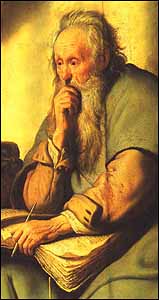
Image: Detail from Rembrandt's St. Paul in Prison
(If your preference in scripture is the King James, or the NIV, or some other version, go there and read the passage. It will say the same thing, different wording perhaps. But the charge is the same.)
Image: Detail from Rembrandt's St. Paul in Prison
Sunday, August 26, 2012
Lord, Forgive Me
The clerk was a lady of fifty-something. The item was seventeen dollars, plus tax at seven per cent. While she used the calculator to figure the tax, I said, "Eighteen dollars and nineteen cents." She finished her computation and said, "You're good." Chuckling, I said, "I've done a lot of arithmetic."Then I handed her a twenty dollar bill and twenty cents in coin. I am not making this up. She used the calculator to figure my change.
Had she been a girl of seventeen, or even a young woman in her twenties there would have been no surprise; but even fifty-year olds are young enough to have been raised in the totally-electronic-commit-nothing-to-memory age? Guess so. Oh, wait. They have to remember how to punch the buttons on the machine, don't they?
I am trying to find a Sunday School lesson in here someplace, and as I prayerfully pondered the implications of this, I arrived at this conclusion.
I am entirely too critical. The woman was merely doing her job, and doing it, no doubt, within the framework of her training. We completed the deal, I got my product and she got the company's money. So in what way was she lacking? She was competent (able to work the machinery) and pleasant (she smiled as she handed me my penny and the two one dollar bills.) If there is a fault here, and there is, it was not hers.
Jesus said, " Love the Lord thy God with all thy heart, with all thy soul, and with all thy mind. This is the first and great commandment, and the second is like unto it. Love thy neighbor as thyself."*
One cannot maintain a loving spirit toward his fellow-man if he harbors a critical spirit which picks at every little perceived short-coming.
Oh, Lord, forgive me for my critical attitude and teach me love and caring for others. Make a change in me. Amen
*Matthew 22:37-39
Sunday, July 8, 2012
David is King
Based on 2 Samuel 5
David was in Hebron when all the tribes of Israel approached him. Look! We are your kinfolk. When Saul was king you were really running the country. Even God told you that you were the shepherd of his people, Israel.
So all the leaders of Israel sat down with David and they made a treaty, with God as their witness. They anointed David King over Israel.
David was thirty years old when he became king, and he reigned for forty years.
David and his armies marched on Jerusalem, but the Jebusites who dwelt there said, Oh, please. Even the blind and the lame could keep you out of Jerusalem. Go home!
Though the Jebusites were totally convinced that David could not conquer them, he went right ahead and took the fortress of Zion and made the city his home, calling it “City of David.”
He prospered there and built up the city. God was with him.
Hiram, King of Tyre, sent carpenters, masons and craftsmen along with timbers of cedar to build a house for David. David felt that this was a sure sign that God had confirmed him as Israel’s king, and that the kingdom was recognized by the world at large.
David took wives and concubines in Jerusalem and had a bunch of kids.
And when the Philistines heard that David was king they came down against
him. But God was with David and assured him of victory against them, which he
achieved. Twice. He ran them plumb out of the country.
David was in Hebron when all the tribes of Israel approached him. Look! We are your kinfolk. When Saul was king you were really running the country. Even God told you that you were the shepherd of his people, Israel.
So all the leaders of Israel sat down with David and they made a treaty, with God as their witness. They anointed David King over Israel.
David was thirty years old when he became king, and he reigned for forty years.
David and his armies marched on Jerusalem, but the Jebusites who dwelt there said, Oh, please. Even the blind and the lame could keep you out of Jerusalem. Go home!
Though the Jebusites were totally convinced that David could not conquer them, he went right ahead and took the fortress of Zion and made the city his home, calling it “City of David.”
He prospered there and built up the city. God was with him.
Hiram, King of Tyre, sent carpenters, masons and craftsmen along with timbers of cedar to build a house for David. David felt that this was a sure sign that God had confirmed him as Israel’s king, and that the kingdom was recognized by the world at large.
David took wives and concubines in Jerusalem and had a bunch of kids.
- Takeaway: David was beloved of God. Since this is so, clearly you, too, are beloved of God. David did not live a perfect life; in fact, he was the epitome of the flawed human nature which inhabits us all. God loves us anyway.
- If that is true, then is it okay for us to live our lives randomly and recklessly, cherishing our sins and polishing our egos? Not at all. To receive the love of God, we reciprocate that love, and in so doing we will want to live as God wants us to live. God will empower us to live the life He has planned for us, and we will thereby reap reward beyond our wildest imaginings.
Sunday, June 24, 2012
They That are with Us
The King of Syria came down upon Israel. He counseled with his men, saying
we shall camp just there. But Elisha warned the King of Israel to avoid that
spot; and this happened yet again, and again. The Syrian King was so vexed that
he called his cabinet together and demanded, “Which of you is for Israel? And
they answered and said, “None of us. It is Elisha that tells the Israelite King
even those most secret words you speak in your bedroom.”
Then the King demanded to know where this Elisha person was, and it was
told him that he was in Dothan. So he sent a great host of men with horses and
chariots down to Dothan by night, and surrounded the city. When Elisha’s
servant arose and went out he beheld this sight. He ran to Elisha and said,
“Alas, my master! What shall we do?" And Elisha answered and said, “Chill. Have
no fear: for they that are with us are more than they that are with them.” and
he prayed and said, “Lord, open his eyes that he may see; and the young man’s
eyes were opened and he saw. The mountain was filled with horses and chariots
of fire all around Elisha.
When the Syrians came down to him, Elisha again prayed, “Lord, smite these people blind.” and so it was. Then the Man of God told them, “This is not the way, nor is it the city. Come, I will take you to the man you seek.” So he took them into Samaria and prayed the Lord to open their eyes. And when they saw, they beheld that they were in the midst of Samaria. And the Israelite King said to Elisha, “My father, shall I smite them?”
“Nah,” said Elisha. You wouldn’t smite those that you captured by the sword and the bow. Set food and water before them that they may eat and drink, then send them on their way. The Syrians ceased for a time from pestering Israel. (Based on 2 Kings 6)
What are we to take away from this account?
Then the King demanded to know where this Elisha person was, and it was
told him that he was in Dothan. So he sent a great host of men with horses and
chariots down to Dothan by night, and surrounded the city. When Elisha’s
servant arose and went out he beheld this sight. He ran to Elisha and said,
“Alas, my master! What shall we do?" And Elisha answered and said, “Chill. Have
no fear: for they that are with us are more than they that are with them.” and
he prayed and said, “Lord, open his eyes that he may see; and the young man’s
eyes were opened and he saw. The mountain was filled with horses and chariots
of fire all around Elisha.When the Syrians came down to him, Elisha again prayed, “Lord, smite these people blind.” and so it was. Then the Man of God told them, “This is not the way, nor is it the city. Come, I will take you to the man you seek.” So he took them into Samaria and prayed the Lord to open their eyes. And when they saw, they beheld that they were in the midst of Samaria. And the Israelite King said to Elisha, “My father, shall I smite them?”
“Nah,” said Elisha. You wouldn’t smite those that you captured by the sword and the bow. Set food and water before them that they may eat and drink, then send them on their way. The Syrians ceased for a time from pestering Israel. (Based on 2 Kings 6)
What are we to take away from this account?
1. Elisha was not called "the Man of God" for nothing.
2. Elisha kept his cool in a troubling circumstance.
3. Elisha prayed, not once, but at each turn of events.
4. Elisha saw clearly God's power in the event.
5. Finally, Elisha dispensed mercy when he could have just as easily meted out death.
What key phrase should we commit to our heart's storehouse?
--They that be with us are more than they that be with them."--
When we give control to God, there is no foe who can overcome us, for He provides a host sufficient to overpower the evil that would swamp us.
Subscribe to:
Posts (Atom)