Showing posts with label Colorado. Show all posts

Friday, July 5, 2019

Eighty-five, Man Alive!

Can that be true?  Is it possible that I have lived 85 years?
It is; it is!

 Here is the intersection of 85 with 85:  As a lad I lived in Colorado Springs through which the major north-south highway was US 85/87. Up and down that road untold numbers of times on bicycle, by automobile, and even short portions of it on foot.  When I left those environs at the age of 18 I am sure it never occurred to me that I would live 85 years.  Or maybe I hoped I might, who knows? 

Fyi, US 85 runs from the Mexican border in El Paso to the Canadian border in North Dakota. It is sometimes called the CanAm Highway.  As a boy I traversed this road many times with the parents, or that is the section between Pueblo and Denver.  I believe the farthest point south we achieved was Albuquerque.  When I left the Springs in favor of the PNW I took 85 north into Wyoming as far as US 30.

I have taken many roads since then, speaking not only geographically but in all areas of my life.  Some of those roads were smooth, straight and easy sailing.  But not all of them.


Tuesday, January 3, 2017

Earl Cecil and the Magpie #T

 Our family moved from Nebraska to Canon City, Colorado the day before my fifth birthday.  Dad was the new pastor of the little church, not yet built, on the corner of Seventh and Floral.  The King family lived on the south edge of town, on the other side of the Arkansas River.  This family attended our church.  They had two teenage daughters, a son, Earl Cecil, about my age, and a younger daughter.  A friendship developed between us boys to the extent that for the most part we saw each other on Sundays as we attended different schools and our homes were not quite within walking distance of each other.

The Kings kept and raised a few hogs and at butchering time Dad would assist Mr. King with the chore of turning the pigs into meat.  This provided an additional opportunity for playtime with Earl Cecil.  To the best of my memory, I never heard anyone call this child anything other than Earl Cecil.  It was almost as if it were one name, Earlcecil.  But back to the story.  When we were probably about eight or nine years of age, Earl Cecil and the Kings moved to Las Animas.

Then Virginia and Marilyn, now young women, decided that marriage represented the life for them and as good fortune would have it each found the man of her dreams at about the same time and I suppose courtships ensued.  The girls decided a double wedding would be the ticket and they asked my parent to perform the ceremony.  The appointed day arrived, and our family made the trip to Las Animas.  It would possibly be a bit understated if I were to say that Earl Cecil and I were less than excited about the wedding and all the attendant folderol, but we were delighted to have the opportunity to catch up and spend time with each other simply horsing around and doing stuff that nine-year-old boys do.
Image result for magpie

And Earl Cecil had a magpie!  His very own personal pet magpie.  He had been told, and he told me, that were a magpie to be captured about the time it fledged one could clip a tendon or some such thing under the bird's tongue and the bird could be taught to talk.  Which is exactly what the kid did, for on his farm there was no scarcity of magpies.

Could the birdie talk?  Indeed it could.  "Hello."  "Dirty bird."  And probably not much more.  I do not recall exactly but I think its vocabulary was limited.

But of course, I envied my friend and always wanted my own magpie, a desire which so far has not been fulfilled.

It is said that the magpie is the brightest of birds and the most intelligent of all the animals.  I have read stories of magpies calling the family dog by name and waiting for the beast to come to it.  Anyway. . .

Stat feed tells me that this is post number 2500 on String Too Short to Tie.

Thursday, March 10, 2016

Zoo on a Mountain

Cheyenne Mountain Zoo opened its gates to the public in 1926, thanks to Spencer Penrose.  The zoo has cared for its creatures and provided educational opportunities to the people of the Pikes Peak area for ninety years.  The zoo is on 140 acres on the side of Cheyenne Mountain of which forty acres is occupied by the zoo itself.  It is laid out in such a way that one hikes up the side of the mountain as he observes the creatures in their individual habitats, then continuing onward, turns down again toward the exit. 


Now a memory from the mid-40s when I was perhaps 11 or 12 years of age.  We lived no more than twelve miles from the zoo so it was an easy day-excursion.  My Aunt Bill and three of her children, then in their teens, were visiting us from Kansas, that magical Land of Oz.  On this day Mom, having prepared sack lunches for the gang, and Dad having insured sufficient gas for the outing, crammed the gang into the car, and off to the adventure!

The details of the day have naturally been largely lost in the mists of time, but a vivid episode imprinted itself upon my memory such that virtually every step for a few hundred yards, every word spoken as we made those steps, are still in my mind.  We had probably eaten our lunches in a rest area midway through the trek.  We no doubt oohed and aahed over the antics of the gibbons and monkeys, admired the plumage and overall beauty of the creatures in the aviary, were satisfyingly repulsed by the creatures that creep and crawl on the earth without benefit of external appendages.  Now we had made the turn, headed down hill, the enclosures for the beasts over the wall to our left as we descended.

We were almost within sight of the parking lot, but for a remaining turn in the road, when we came to a display representative of an African veldt which was populated with animals indigenous to that far-distant part of the world.  This included a few spotted hyenas, one of which seemed as curious about us as we were interested in it.  Here Cousin Ward said, "Make him laugh, Uncle Delbert."

Now my father was noted for his uproarious laughter when he was in a jovial mood.  Dad liked the idea and burst forth with his trademark roar, which did indeed resemble the call of the hyena.  "Now, Delbert, you ornery thing," my mother said as she headed on down the hill, insisting that the rest of us come along.  Ward and Dad stayed with the canids.  As we were rounding the last curve we could hear from behind not only Dad's laughter, but a response from the hyena.  What an uproar when its companions started barking as well.  Father's laughter turned from teasing to genuine out-and-out hilarity, the cacophony increased as the other inhabitants of the zoo joined in-- the screaming of the monkeys, the squawking of the macaws, the roar of the lion, and by the time the elephant trumpeting began Dad and his nephew had caught up with the women and children.  We all hastened to the car, somehow again fitting eight people into a vehicle designed to transport five, six at most, and departed the premises.

Image: Wikipedia

Tuesday, September 22, 2015

Early Memories #T

Lying abed in Grandpa and Grandma Morrell's home in Hartman, the house where I was born, and hearing Grandma, Mama, and the Aunts in the kitchen chitter-chattering.  Oh, the secrets I might learn if I could only lie still and keep my ears open!

I do not remember any earth-shattering information I gathered, but I do vividly recall this experience.  I know I was not yet five years of age, for we had driven down from our home in Nebraska.  The car, which I remember clearly, was a 1928 Chevrolet, a detail which I probably filled in a bit later.  The vehicle was a two-door sedan, dark green body with black fenders.  It had solid steel wheels, not spoked.

Returning to Nebraska late at night, lying in the backseat watching the moon race the car as we sped toward home.  I think I woke up in my own bed the next morning and I don't know how the race turned out.

Our neighbor, Mrs. Anderson, had a radio in a huge cabinet, about as tall as I.  I vividly recall a bright green light in the center of the console that resembled an eye.  Little people lived inside the cabinet and when the knob on the left was turned they would talk to you!  I could not figure how they got in there, nor how they obtained sustenance.

I learned about the qualities of shrinking objects on a trip to Lincoln.  High up in a building in a region accessed by a little room that slid up and down inside the building, one could look out a window and see far, far below, the tiniest little automobiles and such ant-like two-legged creatures hustling hither and thither!  Back on the street level, all these wonders had returned to normal size.

Monday, July 27, 2015

Watermelon Man

Early in May BBBH came wagging a watermelon home.  At that time, I told you about her love for this delicious cucurbit.  In all fairness, I should mention that she is not the only one in this household who likes this treat.

Let us say it is the summer of 1944.  I am ten years old, Sister is seven.  The entire family, Mom, Dad, and the two kids are in the car.  We are going to the Safeway on a hot summer day.  Weird, you are thinking.  No, it is not.  Mother doesn't drive and the grocery shopping is a family excursion.

I spare you the detail and place us all back in the old Ford for the trip home with the groceries.  (It should be understood that the purchases at the grocery store tended to be staples: flour, sugar, baking soda, raisins perhaps, in general, stuff Dad could not grow or kill.)  Anyway, at the corner of Spruce and Colorado Avenue we will turn north.  And on that very corner is the Watermelon Man!  A pickup truck load of the beautiful things up from The Valley.  "Oh, Daddy! Can we have a watermelon? Can we, hunh?" I'm not sure which of us said it first, Sister or Me, but the other immediately chimed in with "Yeah, Daddy, can we, please?"

Then the devastating response.  "Four and a half cents a pound.  Way too much.  We'll have to wait until is down to two cents."

So we waited.  And watched the prices as the days passed.  Now the salivary glands flood our mouths as we pass the watermelon stands.  And then "Melons 21/¢."

"Please, Daddy. Please, please!"

And he caves.  "Well, it's still a little high, but I think I have fifty cents, so if we can find one under twenty pounds, we'll get it!"

Watermelon Man plugs the chosen melon, it is every bit as good as we had hoped, and a happy family heads home with the treasure!


Painting by A. F. King


Word of the day:  plug, in the given context.

Monday, January 19, 2015

Provender

W. F. Drown and D. W. Lacy

During the years my father, D. W. Lacy, was President of Colorado Springs Bible College, gathering food and provisions to feed students and staff was a high priority.  The school acquired an old Ford two and one-half ton truck, military surplus, which was used in this endeavor.  Someone painted the vehicle black to cover the standard olive drab and thus, to some extent, disguise its origins.

Each fall the truck made a trip to Palisades, Colorado to get a load of peaches.  These were brought back to the school's kitchen where volunteers prepared and canned them for use over the winter.  My mother was always one of those workers.

The vehicle also made an annual trip to Saguache, Colorado to get a load of potatoes which were then sorted and stored in the produce cellars in the hillside next to the dining hall.

I recall as a thirteen-year old boy, making such a trip as ride-along to Dad, basically dead weight, but what memories for me!  Coming back from the Western Slope, middle of the night, the truck groaning and laboring in granny to get the load up the pass, I lying atop the peaches listening to the rur-rur-rur of the machine.

In the picture above we see Mr. Drown who was Rocky Mountain District Superintendent and a member of the school board, along with the President of the school, working outside the kitchen to prepare the produce.

Wednesday, January 14, 2015

History and Geography...

...which the schools years ago lumped together with civics and economics and called it "social studies."  The state of the world today is testimony to the outcome of that.  Perhaps.  Just a thought.

But that is not why I chose the title.  Rather, it has to do with this picture.  There will be a test.


Test

1.  Where was the picture taken?
2.  Within six years, when was the picture taken?  (Credit if you can name the decade.)
3.  Who is the individual in the picture?  (That's a gimme.)
4.  What would you call those trousers?  (If you didn't laugh out loud, you really didn't look.)

Thursday, May 22, 2014

God's Rubble #T

Did I tell you about our trip to the mountains?  Oh, yeah, I recollect I was tellin’ you we were at th' Royal Gorge.  Well, sir, that same afternoon we drive on up to Cotopaxi, find a spot by the river ‘n pitch our tent.  Got the tackle out and flung our lines in th’ river.  We catch three nice rainbows, oh, ten, eleven inches. ‘Course I caught one an 'em, ‘n Grace, she caught two.  Always have to best me, thet woman.  Waal, they was mighty fine eatin’, cook as they were in the arn skillet we bring along.  Your Aunt Grace, she make some fry-bread to go along with, an’ a han’ful a coffee in th’ ol’ tin pot asittin’ on the farr.  Moughty fine.  Mought near as good a meal I ever eat.

Son, I tell ya, sleepin’ on the ground, nothin’ but a ol’ comforter underbeneath me is no way for a feller to treat his ol’ body.  Thet will not happen again, no matter what a hotel mought cost.  So I finely get upright in the mornin’ and got the ol’ bones to move on thoo the aches ‘n pains.  We get a good start, anyway, drive on up to Salida.  Pretty little town, tho’ I can’t fer the life a me see whut for people live up there.  Nice scenery, can’t eat it.

So we drive on up to Buena Vista, lovely scenery along the way, your Aunt Grace say.  Now we are up by the headwaters our Arkansas River, it come a bubblin’ down out the mountains.  We drive on up to Leadville, that little V-8 85 workin’ it’s heart out, but she don’t falter, no sir.  Now we drive thoo the barennest places I ever see, higher, higher, climb right to the top a th’ world.  Nothin’ness ever’where ya look.  Even Grace, who see beauty in ever’thing, say, “What do you suppose the Good Lord want with so much rocks and bare lan'?”

Waal, I fancy I know th' answer to thet.  I tell her, “Hon,” I say, “the Bible say God create ever’thin' in six days, an’ He rest on the seventh.  Now he mought nigh get done with his work, ‘n he see thet th’ sun have gone down, night acomin’ on.  So he have all this leftover scrap, ‘n he gotta dis-pose of it afore dark, so He tuk and dump it all out here in the middle a Colorado!”

“You ol’ fool,” say Grace.  “Well, no; maybe  you are right this time.  I sure see no use for all these rocks."

Waal, t’make a long story short, we go on into Leadville, try to visit one a them there mines, jes’ ta see what the fuss is all about.  Prollem is, catchin’ one’s breath up there is not all thet easy.  Like ta starve for air.  Grace, she suggest we stay in thet ol’ hotel over yonder, ‘n I say I druther die on the road then to hafta stay in this place another hour.  I’ma wantin’ home really bad.  So we get in the truck an’ head on out.  Darkness catch us just past Salida, but I’ma goin’ home.  Did her, too.  Find a station in Canon, fill ‘er up, ‘n drive on thoo the night.  We get home two o’clock in th’ mornin’ and if’n I never get out the county again in my lifetime, hit will be plenty soon enough.

© 2014 David W. Lacy  31

Monday, April 14, 2014

Jiggs #T

When I was a lad, perhaps six or seven years of age, a dog came to live with us.  I was never sure of the details concerning the acquisition of the beast, but I don't believe he was a stray.  I think Dad had rescued him from some circumstance from which he needed to be free and persuaded Mama that it was the right thing to do.  The dog was housebroken and a good pet, ostensibly for the kids, but there has never been any question that Jiggs was Dad's dog.

Sister and I may have been "involved" in the naming of the dog, I really don't remember.  But again, I have no doubt that the chosen name was the name Dad chose, or would have chosen.  I cannot prove this, either, as so much fades into the mists of the past, but knowing my father as I did I suspect that he lifted the name directly from the comics page in our little local newspaper.  Dad, many times over the course of his life, said, "The only thing you can believe in the newspaper is the funnies page."  And I do know for a fact that Amos Hoople, Alley Oop, and Jiggs and Maggie were among his favorite literary characters.  Hence, the dog's name was Jiggs, or as he came to be known during the two or three years of his residence with us, "Old Jiggs."

The animal was referred to as a fox terrier, and there is no doubt that his parentage was predominantly terrier.  He was mostly white, with black and brown markings.  He would have weighed perhaps twenty-five pounds.  He ate the same things the family ate, assuming there was something left for the dog.  Kidding.  He always got something to eat.  Jiggs was a good house pet, and a suitable companion for the children, both under ten years of age.  But let Mama pick up a broom, and Jiggs's tail instantly protected the underside of his body, as he crouched and slunk out of sight, could he find a place to hide.  Clearly, the dog had suffered mistreatment sometime in his life, but never at the hands of any of the occupants of our house.

Jiggs was otherwise fearless. He never offered to attack or even offend a human. Dogs, on the other hand, were all fair game, size or disposition notwithstanding.  He was an obedient dog, though. He sat on our front stoop, but he would leap down to attack a passing dog only if granted permission to do so .  One of my father's delights with this dog was to sit beside him on the top step watching the world go by. When a dog would approach, Jiggs would prick his ears, thrust his muzzle forward, raise the hackles on his back, thus announcing his intention to vanquish the would-be intruder.  As the offending outsider would pass our walk, Jiggs would start to tremble. Yet there he would stand until Dad offered the magic words:  "Sic 'im, Jiggs!"  Then like a lightning bolt unleashed from a storm cloud, the animal would explode from the porch in hot pursuit of his prey.

I vividly recall watching this tableau play out on more than one occasion when the "victim" was a St. Bernard that lived two blocks up the street, and was given to taking his morning stroll past our place. Unaccompanied. Most dogs walked themselves in that time and place, for the dogs were no doubt brighter in those days than are the namby-pamby creatures we harbor these days.  They were perfectly capable of walking themselves.  And they did.  Anyway, "Sic 'im, Jiggs!" would set Jiggs on this behemoth which no doubt weighed northward of 175 pounds.  Jiggs would burst from the yard, pursue his target, and leap upon the great Saint's back, landing on all four feet and securing his position by taking the scruff of his foe in his teeth.  The Saint would amble on, never missing a stride.  And Jiggs would persevere half or three-quarters of a block, until he heard Dad's shrill whistle, which called him home, just as that whistle would call home the Sister and I if we were out of sight at supper time.

Tuesday, August 27, 2013

Conversations with Random People: One #T

I am neither the most affable nor the most sociable person in the county, but people interest me.  I find that if I show an inkling of that interest to a near-stranger, or even a complete stranger, an interesting conversation is likely to ensue.

There are snobs and too-busy-to-live types who won't give anybody beneath the rank of "Earl" the time of day; but I am not talking about them.  I am talking about most people.  For the simple reason that 1) I have not cleared the presentation of these accounts with the principals, and 2) in some cases I don't even know the real names of the participants, I am using random names from, well, a "What to Name the Baby" book, if you will.

In a campground in Texas which we have frequented on several occasions.

We met Candy and her husband Jim at Sunday morning church service.  A conversation on our way out led to the discovery that while she is twenty years my junior, Candy and I were born in the same county in Southeastern Colorado.  The two little towns of our nativity are less than eight miles apart.  While my parents moved us away from there when I was yet an infant, Candy grew up in her home town and graduated high school there.

I have been in Candy's little town many times, and in fact when I was a child I had an uncle who lived there.  We visited Uncle Wayne and his family on a number of occasions.

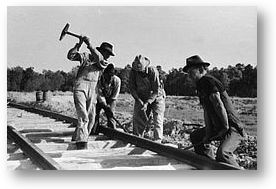
The lady asked me where Uncle lived, and I told her he was the section foreman for the Santa Fe and he lived in the company house beside the tracks at the west edge of town.

It is I with Uncle Wayne and Aunt Stella in Southeastern Colorado.


"That," said Candy, "is very interesting.  My grandfather probably worked for your Uncle, for he was one of the Mexican citizens who came to the States to work on the railroad.  He came to America with the promise of a job, and ultimately citizenship if he so desired.  My grandfather chose to become an American, and that is how I happened to be born in Colorado!"

Interesting, indeed.

Gandy dancers.

Wednesday, August 1, 2012

Centennial State

August 1, 1876, President Grant signed the Act which officially admitted Colorado to the Union as its thirty-eighth state.

The Colorado Territory was formed in 1861 When Kansas was officially admitted to the Union as a state.  Colorado Territory was created from pieces of the territories of Kansas, Nebraska, New Mexico and Utah.  The original boundaries of the Territory are Colorado's boundaries today.  Colorado has no boundaries which are natural features; it is strictly defined by survey.

I am partial to Colorado,  because I am a native Coloradan, though I have not lived there in sixty years.  I was born in Prowers County in the southeastern part of the state.  So close, in fact, to the state line that I barely missed being born in Kansas!  Except for the first five years of my life, I grew up in Colorado, living in Canon City and Colorado Springs.  I graduated Colorado Springs High School, then deserted my native state to roam this vast country we call America.

For natural beauty and diverse scenery, Colorado cannot be topped.  Well, literally, one might say, for the highest point of elevation in the State is Mt. Elbert at 14,440 feet, one of 52 peaks that top 14,000 feet.  But it's lowest point on the High Plains is 3317 feet above sea level, higher than any point in 18 other states!

Colorado is the "Centennial State" for it was admitted 100 years after our Declaration of Independence.

As an eighth grader, I studied Colorado history which was required of all eighth graders.  I found it quite interesting, and I have to this day several books which deal with the history of the territory and the state.  Unrelated factoid: when I sought employment as a teacher in the State of Indiana, it seemed for a bit that my failure to have studied Indiana history was going to block me from the classroom, or I was going to have to take a college-level course to satisfy the requirement.  Some how, thank goodness, I obtained a "special dispensation" and though I have read a good bit of Indiana history over the years, I am one of very few people licensed to teach in Indiana who never officially studied the state history.