Showing posts with label 1940s. Show all posts

Thursday, April 12, 2018

California, Fourth Trip


This one was a road trip.  Mom, Dad, kids in the car-- you may be familiar with the drill.  The vehicle was a '41 Chrysler Royal club coupe, a car with but two doors but adequate seating for six.  Remember, no seat belts, no kiddie seats and, which became an issue eventually, no air conditioning.

"Are we there yet?"

Actually, no.  It was a long trip from Colorado Springs to Ventura, US 85-87 to Route 66, on to Southern California.

A few memories:

I remember somewhat the anticipation of seeing the Petrified Forest and the disappointment I felt, but did not express, when upon passing through all I saw was a bunch of rocks-- no trees.  What kind of forest is that?

I seem to recall jogging south from Flagstaff and driving through Oak Creek Canyon and being duly impressed with the town of Jerome, clinging as it was to the mountainside, clothes flapping on the lines which were on pulleys so the laundry could be reeled in.  I mean, there were no yards.

 The drive from Needles to Barstow was hot (remember, no AC) and interminable.  Oh, not really interminable. I think it was in Barstow that I saw my first date palm.  Quite impressive.

I will make no attempt to retrace the visits to the grandparents, the uncles and aunts, cousins, and so on around Ventura, San Fernando, Riverside and points thither and yon.

An amusing recollection from the return trip is this.  My mother, who was in her late thirties at the time, had never driven an automobile.  Somewhere in the desert in New Mexico, the parents, probably mostly Dad, decided that Mama should learn to drive, and here was the ideal spot for that!  Dad pulled over and the parents exchanged seats.  Mom actually got the car into the driving lane and headed down the road.  She may have driven as much as fifteen or twenty miles, Dad instructing her the full time, you understand, and soon my little mother was a nervous wreck, pulled over to the side of the road, stopped the car and got out, walked around to the other side the vehicle.  So far as I know Mother never got behind the wheel of a car again in her life.

I thought I had posted an article some years back describing the most memorable part of this journey, but no, apparently I did not, for I cannot find it.  That will require another post.


Tuesday, April 10, 2018

California Again: Trip Three

Image result for 1937 chevrolet In 1944 we moved to Colorado Springs but Mother's family was still in California so another trip was planned, this one a bit different from the two previous trips.

The war was still on and rationing was still in effect. Gasoline was severely limited.  But Dad had a "C" coupon due to his occupation.  He had a friend in the same line of work who had the same rationing status and he had a 1937 Chevrolet.  He and his wife wanted to make a trip to California but there was the gasoline issue.  The parents decided that Mom and the kids could make the trip with Mr. and Mrs. Meyers and by sharing gasoline rationing stamps they calculated the trip was possible.

So three adults, two children along with luggage took off in the old Chevy, California bound!  And just how was this trip memorable?  In order to conserve fuel, Mr. Meyers calculated that a speed limit of 35 miles per hour would best serve that end.  Therefore from Colorado Springs to Southern California and back, the car never exceeded a speed of 35.

It was a long trip.

Thursday, April 5, 2018

Second California Trip

Our next family trip to Sunny Southern California occurred either a year or two years later than the Santa Fe trip described earlier, I think in 1943.  We took the Rio Grande Road through the Royal Gorge (which was a mere eight miles from our domicile) and over Tennessee Pass, on into Utah where we changed trains in Salt Lake City.

The most striking thing to my nine-year old mind was the crowded conditions on the train.  This was at the height of World War II and troop movements were being facilitated by every means available.  The train was overflowing with troops, most of whom were in fatigues and carrying huge duffel bags which were used as bolsters on which to lie as they filled the aisles.  Every available space seemed to be filled with a human body or its belongings.  Actually, I don't remember much more about the journey.

My sister, Vee, in a comment on the previous post, reminded me of a number of things I might mention about our visit to Ventura and the San Fernando area.  She recalled the black paint on the top half of the auto headlights and the fear of bombing by the Japanese.  Add to that my recollection of the dirigibles floating in the sky with cables hanging down in which to entangle any undesirable aircraft.  She also mentioned that the kids were admonished to be quiet so as not to disturb the neighbors.  I did think it odd to have strangers living on the other side of the wall in the same house.  Duplex, I think they called it.  Our Indiana friends call them doubles.

It was at Ventura that I first saw an ocean and I must say I was duly impressed.

https://upload.wikimedia.org/wikipedia/commons/f/f0/Denver_%26_Rio_Grande_Western_Depot_in_SLC_-_Feb_3%2C_2011.jpg 


Rio Grande Depot, Salt Lake City


Tuesday, April 3, 2018

First Trip to California #T

I recall four trips from Colorado to California during the 1940s.  Details are sketchy, but vignettes were impressed deeply in my memory.  I would have been about seven years of age during the first of these trips, thirteen at the time of the last.

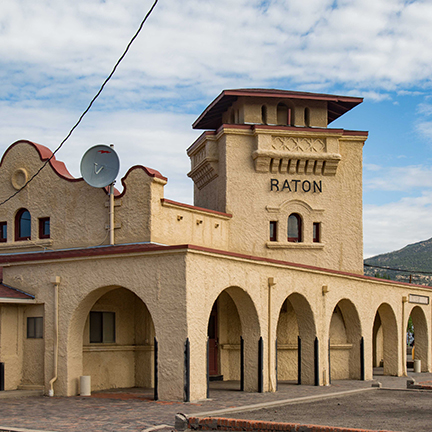
The first journey was from Canon City to Los Angeles via the Santa Fe.  This would have been, I think, in 1941.  We, the family I mean, boarded the train at Pueblo and traveled through Raton Pass into New Mexico, and this provided one of the most vivid memories of the trip.  The train was drawn by a steam engine.  The Super Chief War Bonnet powered by diesel electric also ran this route but we were not Hollywood celebrities or movers and shakers.

At Trinidad helper engines were added to the train to assist it in making the grade and a very steep grade it is at 3.5%, which my seven-year old self did not know.  I looked it up.  The locomotives were chuffing up the grade, smoke pouring copiously into the atmosphere.  We discovered that on certain curves one could look out the window of our car and see the engine in the rear pushing us along.  I can see it yet.  Mallet, Dad said.  Mallay, I  heard, which is the pronunciation of the word.

Santa Fe Station, Raton, New Mexico

 Other bits of memory from this trip include the red peppers hanging on the sides of the houses around Bernalillo and across New Mexico; the more-or-less interminable transit of the desert lands between Albuquerque and Los Angeles; the arrival at Union Station in L.A. where we were met by the Uncle and the reunion with Mother's family began!

Wednesday, November 15, 2017

Backyard Mechanic #T


I saw the motto and knew instantly what was being advertised-- brand name and all.

http://blog.modernmechanix.com/mags/PopularMechanics/2-1941/tough.jpgHow long has it been since you saw an ad for piston rings?  Everyone, well, nearly everyone, owns some but no on gives them a second thought.  That is unless he is a combustion engine mechanic by profession.
Back in the. . .  Well, you know, when I was a lad it was not uncommon for the family vehicle to develop a bad habit of belching smoke due to worn piston rings, among possibly other causes.  It was also not uncommon for Pops, or Daddy by whatever moniker he was known in the household to purchase a set of piston rings and a few other things, pull the car under the shade of the elm, and proceed to correct the problem.

This just isn't done anymore.  Isn't necessary, and scarce is the man who has the know-how to accomplish the task.  We resolve our automotive issues in different ways these days.  But here is a brief story, true story, a memory from my kidhood, circa 1945.  Faithful reader Vee will verify or correct the date.

Little sister having been stricken ill was hospitalized and the appendix was removed.  Daddy had a real concern regarding payment of the accompanying medical bills.  I think I remember numbers, but in the interest of correctness in reporting I shall tell the story without naming dollar amounts.

Dad had access to a small amount of cash but not enough to meet the obligation.  A new neighbor recently moved into town had a 1934 Ford sedan he wished to sell.  But the little V-8 engine was afflicted with the problem cited above, along with other foibles.  Father bought the car, pulled it into a garage on the back alley, and disassembled the engine, laying the parts carefully on the workbench.  We were cautioned, nay warned, that to touch, move, knock over, or in any other manner disturb this arrangement was to put our very lives in peril.  Kidding.  Dad did not threaten our lives, but he made it clear that we might wish we were dead if we messed up his work.

He bought piston rings, some bearings, and whatever else he found he needed, cleaned the old engine, rebuilt it and reassembled it.  He sold the car for enough money to recover his investment and pay off the medical bills.

Hastings had nothing on my father who was also "tough but gentle."

Friday, April 8, 2016

Eggs and Milk

I offered this little vignette a few years ago and read it again yesterday.  It amused me anew. I hope you will enjoy a re-read.   True story and walking up the hill with the male parent is a pleasant memory.
 
The lad is carrying two pails as he walks alongside his dad, footsteps crunch, crunching in the gravel as they walk. One pail is the milk bucket, the other the near-gallon lard can for collecting eggs. Daddy insists that this is the day the boy will "learn to milk the cow."

When they get to the chicken coop, the boy sets the milk pail down and goes in to collect the eggs. For the most part, this is an easy job. Forget the squawking, the feathers flying around-- pft! pft!-- and the dust the birds kick up. Just go to the nests and gently lift the eggs and place them carefully in the bucket. But of course Old Broody will not get off the nest, and when the youngster attempts to reach beneath her, a quick and painful peck on the wrist encourages quick retreat. David steps out of the enclosure with his bucket of treasure and Dad says, "Did you get Old Broody's eggs?" "She wouldn't let me have them." "Get in there and throw her off the nest." You see where this is going-- caught between the mad dad and the angry hen.  So back into the coop, grabbed the hen and threw her across the house.

Now we take the pail and enter the milking stall, where the "little Jersey" patiently awaits the relief she so desperately needs. She places her head in the stanchion, the boy gets the stool and places the bucket beneath the cow, all the time thinking, "There's no way I'm going to milk her." David sits on the stool and tentatively reaches for a teat. The tail whips around the back of the boy's head. He flinches and complains loudly. "Get your head up in her flank. Don't let her push you around." The boy obeys, reaches again for a teat. A bit of fumbling around with no visible result, unless one counts an increasingly impatient cow and ever more impatient "instructor." Finally the mentor gets down and demonstrates the proper finger motions, starts a stream. The boy again fumbles around with the resulting trickle further irritating both animal and parent.

"Get away from her," says the parent, "I'll do it myself." And he did.

The original title is "Red Hen, Red Cow ."

Thursday, April 7, 2016

Yesterday's Poser

About three weeks ago we shared a nostalgic piece about tax tokens and the small role they played in my childhood.  Yesterday we posted a picture of an item which we declared that one had to be really old to remember.

When I was sent to the corner grocery store (which was actually about three blocks away) the little satchel containing the few coins, including tax tokens, also included one of the pictured items to cover the requirement that our household actually was entitled to the purchase Mama ordered.

Rationing stamps came in booklets and the purchaser carefully removed the stamps required for the purchases.  Clearly I was not allowed to carry the booklet to the store, only the needed stamp.  If my memory correctly serves me the "meat" stamps were red and the gasoline stamps were black and for Daddy's use only.

Rationing of coffee reduced each individual 15 years of age and up to one pound of coffee per six weeks.  Coffee-stretching techniques included a supply of chicory in the kitchen.  While rationing was not popular, it was generally accepted as a necessary part of the war effort.  But rationing of coffee was the least popular of all, and President Roosevelt lifted it in July, 1943, the first item to be removed from rationing.*

Anyway, nine-year-old David with three dimes, three tax tokens and a coffee stamp might be entrusted to walk to the store and obtain the required item.  Yes, coffee retailed at about thirty-cents per pound.

*Reference this very interesting article about coffee in 1943.

In front of our grocery store there stood one gasoline pump.  One grasped the handle, pumped up from the ground tank the amount he wished to purchase into the glass cylinder.  Then placing the hose into the car's filler pipe, releasing the nozzle valve allowed gravity to do the rest.  Except for paying the seventeen cents for each gallon purchased.  And don't forget the ration stamps!


Image result for glass cylinder gas pump

Monday, March 28, 2016

Encumbered

 
A part of my boyhood, a very small part because these "tax tokens" were worth a mill, or one-tenth cent up to five mills, or 1/2 cent.  That is, five two mill coins would be the equivalent of a penny. There were twelve states that issued tax tokens.  I lived in one of them.

The coins were variously made of aluminum, plastic, or even cardboard. The purpose was to "save" the customer from being overcharged when he paid the sales tax on small purchases, say a dime on which the tax at 2% would be two mills and paying a penny would lose the customer 4/5th cent.  Not paying at all would cost the state 2/5th cent, hence the creation of the tax token.  Different states issued different denominations, 1,2, and 5 mill values.

The use of these tokens prevailed throughout the thirties and into the forties.  Eventually someone figured out that the whole thing was too cumbersome, yet the government could not afford to simply eliminate the sales tax, so the bracketed tax was devised.  Say at 2% the table would indicate a tax on purchases of one to twenty-four cents would be zero; from twenty=five to seventy-four cents, one cent tax; seventy-five to $1.24, two cents, and so on.  This required the publication of sales tax tables for the merchant and the general public.  Which of course was not cumbersome..  Or perhaps it was, who knows?  This method is still being used in some states,  Except of course a two-percent tax is a long-dead dream.  Also some municipalities have jumped on the bandwagon and imposed their own sales taxes in addition to the statewide taxes.  In some states these now total as much as 9.45%.  Ours is seven percent except in certain cities where it is more, at least on some items.

And.  Some states have a tiered system in which the tax rates vary for different items purchased.

The mind of man is infinitely convoluted and forever seeking more ways to complicate our lives.

 Image:By $1LENCE D00600D at English Wikipedia, CC BY-SA 3.0, https://commons.wikimedia.org/w/index.php?curid=32892050

Thursday, January 7, 2016

Watchamacallit

Monday's story at one point featured a thunder mug.  Pictured here is our chamber pot, complete with lid, unlike the one sold by Eli.  Yes, we have one.  An unused item, to be sure, but there it is nevertheless.

Writing about this appliance sent me on a trip via the Wayback Machine as my friend Chuck calls it.

In 1942 we were living in Canon City, Colorado.  We had all the conveniences of running water but the flush toilet was situated in its own building at the alley.  Generally speaking I believe it was the rule that one relieved himself before bedtime and he was expected to perform next in the morning on rising. This would not work for me now.

In June of that year my parents made a trip to Owosso, Michigan where the father was a delegate to the Quadrennial General Assembly of his church.  They boarded us with their close friends Eldon and Leah Bolander whom we referred to as "Brother and Sister Bolander."  Kiddies did not under any circumstances call their elders by their first names, nor did they refer to them that way.  The Bolanders had a daughter, Grace, who is three years my senior.  My sister Vee is three years my junior.

A distinct memory involves doing dishes after the meal.  I recall a chastisement I received from Sister Bolander on one occasion when it was my turn to dry.  I had set down a plate in the stack of dried dishes when the hostess stepped beside me to inspect the work.  "David," she said, "this won't do.  This dish is crying.  See, there are still tears running down its face."

And now to the chamber pot.  There was a slop jar in the guest room.  It was kept under the bed and its use was explained to us.  Yet we were strongly encouraged to avoid the necessity of availing ourselves of its use, for if it were utilized it should have to be emptied properly and scoured clean first thing in the morning.  I think I never used it.


Tuesday, August 18, 2015

A Memorable Christmas


It was perhaps the year I was nine though more likely when I was eight. I am thinking eight because that was the year I was in grade three, the year I had the tonsillectomy, the year I missed nearly as many days of school as I attended; the year the teacher had no name.  Okay, she had a name, I suppose, but I cannot remember it.  I may have erased her the day she smacked the back of my hand with the ruler, which is about the only thing I remember about her.

This account is written in the first person whereas in most of my school tales I have identified myself as "The Boy."  This is not a school tale as such.  This particular year as the Christmas wish book arrived from Monkey Wards I began to dream my Christmas dreams.  And I wanted one thing under the tree this year.  This item was so precious, so dear in cost, that I knew to dream of more things besides would place me squarely in the realm of fantasy.  I wanted This. One. Thing.

A Wood Burning Set.

I had never used such a thing.  So far as I know I had never even seen such a thing but Montgomery Ward told me it existed.  And that I needed it.  Lust began.  But dare I hope?  Well, I did.  Hints dropped, days passed.  Hints became less subtle to the point that even Father knew what his only son wanted.

Then Christmas came, as Christmas will.  Sister and I, still p.j. clad, rushed to the tree, and behold there was a package for me which approximated the size I imagined would contain

My Wood Burning Set.
And it did!

I played with that thing a bunch yet no memorable events occurred, neither untoward accident nor fantastic creation.  No physical mementos of my efforts survive.  If I created anything no one remembers it nor do I.

And eventually I did not use The Gift  anymore.

But what do we say about kids and their toys, and the boxes they came in?


Word of the day: tonsillectomy

Happy birthday to my beloved daughter, Ivanelle, aka Ivy.

Wednesday, February 11, 2015

Amity


Makes us think of the "Stories" tabs at the top of the page.

Monday, January 19, 2015

Provender

W. F. Drown and D. W. Lacy

During the years my father, D. W. Lacy, was President of Colorado Springs Bible College, gathering food and provisions to feed students and staff was a high priority.  The school acquired an old Ford two and one-half ton truck, military surplus, which was used in this endeavor.  Someone painted the vehicle black to cover the standard olive drab and thus, to some extent, disguise its origins.

Each fall the truck made a trip to Palisades, Colorado to get a load of peaches.  These were brought back to the school's kitchen where volunteers prepared and canned them for use over the winter.  My mother was always one of those workers.

The vehicle also made an annual trip to Saguache, Colorado to get a load of potatoes which were then sorted and stored in the produce cellars in the hillside next to the dining hall.

I recall as a thirteen-year old boy, making such a trip as ride-along to Dad, basically dead weight, but what memories for me!  Coming back from the Western Slope, middle of the night, the truck groaning and laboring in granny to get the load up the pass, I lying atop the peaches listening to the rur-rur-rur of the machine.

In the picture above we see Mr. Drown who was Rocky Mountain District Superintendent and a member of the school board, along with the President of the school, working outside the kitchen to prepare the produce.

Thursday, June 5, 2014

A Memorable Moment

It is one of the most undesirable and one of the most important tasks around the place.  Uncle Jep and I are digging a new pit preparatory to moving the outhouse.  It doesn't have to be done often, but when it has to be done, it has to be done.  Mid-afternoon and the zephyr speeds the evaporation that cools our sweaty brows.

"That's got 'er." hollers the Old Uncle, "Come on up.  We need a break afore we start the move.  Worst part now is fillin' th' ol' hole."

I didn't have to be told twice.  Clammered out the pit, admired my handiwork.  A neatly dug hole, if I do say so myself.  We ambled over to the garden where we had left our canteens.  I flopped down on the ground, Uncle sat on Aunt Grace's "prayer bench."  True.  Auntie loved to sit in the garden, listening to the bees and admiring the abundant produce, the grapes on the arbor, the melons on the vines twining through the rows.  And there she would pray, for "It is all a gift from God, and to be ungrateful is one of our worst sins."

I took a long draught from my canteen.  "Ah!  Now, Uncle, give us today's tale."

"Waal,"  he draws the expression out as though it should be written 'way-all,' "I don't have a 'tale' today, but I do have somethin' on my mind thet I been needin' to say to ya.

"You been with me an' yer Aunt Grace how long now? Goin' on four year, I think.  You come over here not dry ahind yer ears, whut?  Sixteen, you were.  I tole Grace, 'I never be able to deal with a teenage kid, all smart-alecky, know ever'thing, they do.'  Waal, I may a been right, but I was wrong. You not on'y a good kid, you have work hard, been a real blessin' to these here two ol' folk.

"Now I know I am a cranky ol' man, can get moughty critical sometime.  But what I hafta say is, You are a son to me.  Never had a chile, y'know.  That is a long an' difficult tale, don't rightly know can I ever tell it you, nor to anyone, come to that.  But Grace and I want you to know that had we ever had a chile, we would have hope hit would be one jus' like you."

Uncle Jep arose from the bench, his old bones audibly creaking.  I rolled over, hopped up from the ground, and we started to stroll back toward our job site. Without a word, on account I was all choked up, doncha know, as Uncle would say, I put my right arm around his shoulder.  He swung his left arm over mine, and we walked just so, back to that hole in the ground.

© 2014 David W. Lacy 33


Monday, May 19, 2014

The '41 Chrysler #T

Shelly suggested that I might present a story about the Chrysler I mentioned a week ago.

My father made his 1936 Ford tudor last throughout the war years.  But he very nearly ran the wheels off it, and thus by 1946 he was feeling the need for a better vehicle.  I am sure he would have liked a new car, but since Detroit had made no cars since early 1942, now that production was beginning again, everybody wanted a new car.  There were waiting lists at all dealerships which had the names of those who thought they could afford to buy new.

Someone of his acquaintance had a 1941 Chrysler Royal Club Coupe. It carried six passengers comfortably.  Father bought the car.  I think I am correct in recalling that he paid $1500 for it, or it may have been that he paid $1300, then had to spend another $200 for repairs.  According to the Bureau of Labor Statistics, that is equivalent to $18,176 in today's money.  Dad's salary that year was one hundred dollars per month, and thus he spent his income for a year and a quarter on this set of wheels.

The car was a beauty.  The picture shows the correct color, although it was not two-tone, but rather all green as the lower body.  This was the first car I ever drove.  I still remember cutting a corner too short on a right turn, running over the curb with the rear wheel.  Dad, in his calm voice, observed, "You cut the hind leg off on that one."  Good times.  My father was an excellent teacher, economy of words his style.  And that is a good thing, for I do not remember ever being "yelled at" while behind the wheel and he beside me.  He taught me how to parallel park in one lesson on a street in downtown Boulder, Colorado.  By following his instructions, which I still follow to this day, I parked it correctly on the first pass.  Still can do.

This was to be the story of the '41 Chrysler, and look.  I have already made it about me.

It was, I think, in summer 1949 and Mother and Father were on their way to Pueblo for a church meeting.  I was working, so my knowledge of the incident is second-hand, as I got it from Dad.  They were almost to their destination when they came to the intersection of highway 85, on which they were traveling, with highway 50.  The stop sign made it clear that it was Dad's responsibility to allow right-of-way to the cross traffic.  He started to slow, gauging his speed and the distance, applied the brake to stop, but instead of stopping, the car skidded right in front of the car coming from his left.  This event is referred to as a collision.

According to the parent, the newly-laid pea gravel on the surface of the tarmac served the function of marbles beneath his tires, and the rest was his responsibility for failure to yield.  The car was in the shop for quite some time, and hence the borrowed '39 Nash became a part of our daily routines.

Finally, though, the Chrysler returned home, and Dad was never happy with it from that day on.  First of all, though it had a new paint job, the color was not quite right.  It was green, yes, but it seemed to have a sort of aqua tint.  But that was not the prime reason for discontent.  No.  The problem was, that in spite of all the subsequent efforts by the mechanics, the car ran down the road crooked.  Oh, it stayed in its lane, but its rear wheels ever after tracked to the right of the front wheels.  It looked, how can I put it?  It looked like a cattywampus old hound running down the road.

It was not long before the car was traded away.  Dad got his first-ever new car, a 1950 Ford Custom fordor.  This car became my first car in 1955.  I traded it in 1958 after it had traversed more than 123,000 miles.

Wednesday, April 30, 2014

May Baskets #T

Children, chances are that were I to say "May basket" you would have no clue.  Here you go, then.  It was in the deep, dark recesses of time past, in that time before there were smart phones, that time before television.  Yes, my dears, there was such a time, and I was eyewitness to that age.  What did one do with himself?  Heavens to Murgatroyd, life must have been a drag.

So you might think.  But that was not the case at all.  Children living in a neighborhood, and that could encompass an area of several square blocks, would gather together and play.  Play?  Yes, play. They would organize themselves, themselves, I tell you, into teams and get up a game of softball. They would play hide-and-go-seek, Red Rover, kick-the-can, or, oh, there were so many games to play!  Quieter activities might include marbles or jacks, hopscotch, I Spy, but now you once again have no clue.

Then on a mid-Spring day we would celebrate May Day.  While the adolescent children might focus on dressing in spring finery and twirling round a Maypole, the younger set would engage in innocent and artistic activities such as the preparation of May baskets.

First, one gets his (or her) crayons, paper, and mucilage.  Nevermind, school paste will do.  After one has made the basket, she (or he) gathers some nice fresh, green grass with which to line the basket.  Then the flowers are gathered.  First of May.  Perhaps a jonquil, if there is one in our own yard-- never steal garden flowers from a neighbor.  Otherwise, some nice, bright dandelions.  A few violets.  See them there, springing up in the grass?  Perhaps some blossoms from the crabapple tree.  Arrange these pretties in the basket.  Now you are ready.

Right after supper and just before dark, twilight, I think it is, we select (in our mind) the recipient of the basket.  We slip across the street, up the sidewalk, and go to the front door of the house.  We hang the basket carefully on the doorknob, or if that is not possible, we set it carefully on the porch in front of the door.  Then, and this is key, then we KNOCK loudly and RUN off the porch and hide behind the hedge were we can watch, but not be seen.

The perplexed householder will look around, look down, espy the basket, and a beautiful smile will brighten his or her countenance!  Or so we hope.

A successful and happy May Day!

Kids, on the next page there are pictorial directions for building a May Basket!

Monday, April 14, 2014

Jiggs #T

When I was a lad, perhaps six or seven years of age, a dog came to live with us.  I was never sure of the details concerning the acquisition of the beast, but I don't believe he was a stray.  I think Dad had rescued him from some circumstance from which he needed to be free and persuaded Mama that it was the right thing to do.  The dog was housebroken and a good pet, ostensibly for the kids, but there has never been any question that Jiggs was Dad's dog.

Sister and I may have been "involved" in the naming of the dog, I really don't remember.  But again, I have no doubt that the chosen name was the name Dad chose, or would have chosen.  I cannot prove this, either, as so much fades into the mists of the past, but knowing my father as I did I suspect that he lifted the name directly from the comics page in our little local newspaper.  Dad, many times over the course of his life, said, "The only thing you can believe in the newspaper is the funnies page."  And I do know for a fact that Amos Hoople, Alley Oop, and Jiggs and Maggie were among his favorite literary characters.  Hence, the dog's name was Jiggs, or as he came to be known during the two or three years of his residence with us, "Old Jiggs."

The animal was referred to as a fox terrier, and there is no doubt that his parentage was predominantly terrier.  He was mostly white, with black and brown markings.  He would have weighed perhaps twenty-five pounds.  He ate the same things the family ate, assuming there was something left for the dog.  Kidding.  He always got something to eat.  Jiggs was a good house pet, and a suitable companion for the children, both under ten years of age.  But let Mama pick up a broom, and Jiggs's tail instantly protected the underside of his body, as he crouched and slunk out of sight, could he find a place to hide.  Clearly, the dog had suffered mistreatment sometime in his life, but never at the hands of any of the occupants of our house.

Jiggs was otherwise fearless. He never offered to attack or even offend a human. Dogs, on the other hand, were all fair game, size or disposition notwithstanding.  He was an obedient dog, though. He sat on our front stoop, but he would leap down to attack a passing dog only if granted permission to do so .  One of my father's delights with this dog was to sit beside him on the top step watching the world go by. When a dog would approach, Jiggs would prick his ears, thrust his muzzle forward, raise the hackles on his back, thus announcing his intention to vanquish the would-be intruder.  As the offending outsider would pass our walk, Jiggs would start to tremble. Yet there he would stand until Dad offered the magic words:  "Sic 'im, Jiggs!"  Then like a lightning bolt unleashed from a storm cloud, the animal would explode from the porch in hot pursuit of his prey.

I vividly recall watching this tableau play out on more than one occasion when the "victim" was a St. Bernard that lived two blocks up the street, and was given to taking his morning stroll past our place. Unaccompanied. Most dogs walked themselves in that time and place, for the dogs were no doubt brighter in those days than are the namby-pamby creatures we harbor these days.  They were perfectly capable of walking themselves.  And they did.  Anyway, "Sic 'im, Jiggs!" would set Jiggs on this behemoth which no doubt weighed northward of 175 pounds.  Jiggs would burst from the yard, pursue his target, and leap upon the great Saint's back, landing on all four feet and securing his position by taking the scruff of his foe in his teeth.  The Saint would amble on, never missing a stride.  And Jiggs would persevere half or three-quarters of a block, until he heard Dad's shrill whistle, which called him home, just as that whistle would call home the Sister and I if we were out of sight at supper time.

Tuesday, February 25, 2014

Sharp Dressers, Dull Town


When I was a lad I was acquainted with a preacher, a friend of my father, whose name was R.R. Sharp.  This occurred in the mid- to late 40s.  

Mr. Sharp was holding a revival meeting in a small town in Southern Nebraska.  The meeting had been advertised in the local paper, and the evangelist had submitted 
a cut in order to run his picture in the advertisement.

The editor was amazed at the minister's likeness, so he made it a point to contact Mr. Sharp during his stay in town.  He related that there was a local business man who, in likeness, was his double; yet they were exact opposites!

The newsman arranged for the gentlemen to meet in front of the local vendor's place of business, and that is where Mr. Sharp met Mr. Dull.

I have had this picture for many years.  Mr. Sharp is on the left, Mr. Dull on the right.