Showing posts with label Christian living. Show all posts

Sunday, March 10, 2019

Rest in Jesus, Not in the Pew

 
And be not conformed to this world: but be ye transformed by the renewing of your mind, 
that ye may prove what is that good, and acceptable, and perfect, will of God.  Romans 12:2

A Canadian blogger, a life-long Seventh Day Adventist, told of  two older people who were brought up in the church, one who was still faithful to the denomination, one who left.  The latter said, We are happy with our decision to leave; we find great blessing in attending the Anglican Church.  The other responded, You are happy belonging to the Anglican Church because it doesn't demand anything of you-- it's a comfortable pew.

The phrase "a comfortable pew" suggests that some people want the benefits of belonging to a church body, but do not want to be inconvenienced with any requirements, any restrictions that might become onerous in any way.

I grew up in a church that imposed rules for living on its membership.  Some of those regulations perhaps more restrictive than even Jesus himself would have asked.  (Or perhaps not:  He asks our all.)  But the point is that in following the guidelines we were reminded that sailing too close to the world entailed the danger of capsizing in the sea of sin and degradation, resulting ultimately in the loss of our souls.

I believe that in its attempt to reach out to the lost the church today in its effort to be "seeker friendly" is in danger of capsizing herself, for we are taught in scripture that we are to come out of the world and be separate from it (2 Corinthians 6:17); to be not conformed to the world but to be transformed (Romans 12:2)

To seek salvation is a good thing.  Jesus himself said, "Seek ye first the kingdom of heaven, and all these things shall be added unto you."  (Matthew 6:33)  This suggests that it is not a comfortable pew we should seek, but rather the Kingdom of heaven and all that that entails.  A comfortable pew does not give spiritual rest, Jesus does.  "Come unto me all ye that labor and are heavy laden and I will give you rest." (Matthew 11:28)  It's in The Book.


Besides, Jesus said all who labor, not all who sit in a comfortable pew.

Sunday, March 3, 2019

Burning Out in a Good Way #T

Flameout

I walked out the front door on a very gray day.  Pulling my eye full into the lower center of the pear tree was a lone leaf among the dark greens and mauves and burgundies, a lone leaf that seemed to light up the world.  I stepped closer and observed that this leaf and all its companions are accompanied by hundreds of little pears. The tree at its most beautiful.  The tree just before its bare branches present themselves to winter's onslaught.

I thought how like this lovely tree are the lives of some people I have known.  Like the tree, they flourished in the springtime of their youth, put forth leaves, and flowers, and ultimately produced the fruit, the seeds within a promise of future life.  Then as they aged, their work finished, an inner glow emanated from them, radiating sunlight and cheer in the environs where they had thrived.  And they know, and we all know, that they will soon fall even as the leaves fall.

Imagine, if you will, a world in which everyone developed such beauty, a world in which our demise would indeed be our finest hour!

Brighten the corner where you are!


While the glory of young men is their strength,
    the splendor of older people is their silver hair.
 --Proverbs 20:29 (Names of God Bible)

Sunday, December 30, 2018

Sunday Devotional


For this Sunday's thoughts on prayer and provision read this piece which was written three years ago.  Be sure to read the comments, for the conversation may be more powerful than the article. --vanilla

God's Mercy

Sunday, September 2, 2018

Jesus in Decapolis

A few months ago the Sunday lesson was taken from the account of the Master's visit to the land of the Gadarenes, or Gergesenes, as they are called in the KJV.  Review here.

Briefly, Jesus had gone to the Heights where he met the demon-possessed, cast the demons into a herd of swine and two thousand animals ran into the sea and drowned

Jesus, it seems to me, made this visit to a strange place in exhibition of this love for all people.  He came to the Gadarenes bearing healing and salvation.  But when the swineherds ran into the city to report the doings of this Jesus in the countryside, the people, the entire city, ran out to him.  Ran out to him seeking his favor?  No! They ran out to him pleading with him to leave their country forthwith.

Now why would they do that?  Loss of the swine, of course.  Those pigs were worth more to them than healing, love, salvation.

What have you in your life that you value so highly that you might ask Jesus to depart and withdraw his gifts?

Matthew 8:28-34

Sunday, July 1, 2018

Klutzy Jesus? #T

I poured myself a nice mug of hot tea, walked into the living room and set it on the table next my recliner.  I seated myself, took up the cup and had a nice sip, swung my arm to the table and set the vessel down an inch past the end of the table.  Beverage, container and all landed on the floor, taking some care to splash a generous amount of the liquid on the front of the recliner as it descended.

I rose calmly from the chair, studiously ignoring Beloved's question, "How did you do that?"  I walked to the utility room and returned with a stack of Turkish towels that reside there for the purpose of mopping up when  the need arises.  I returned to the living room and painstakingly proceeded to clean up my mess.

As I worked this question impinged itself upon my mind:  Did Jesus ever commit a klutzy act such as, say, spilling a flask of wine on his mother's best rug?

Before you blurt out, "Don't be stupid, vanilla," consider this.  We tend to think of Jesus as perfect (which he was) and therefore incapable of committing a faux pas.  Now as I lifted my tired body from the chair to fetch the clean-up materials,  I was not nearly so calm inside though I bit my tongue, stifled my feelings and presented the external actions described in the second paragraph.  As I worked this scripture occurred to me:  "For we have not an high priest which cannot be touched with the feeling of our infirmities; but was in all points tempted like as we are, yet without sin." (Hebrews 4:15)

Now does not that suggest to you as it did to me that Jesus probably spilled a beverage, cracked a board during the construction of a fine table, or some similar experience of the like that we have?
Yet he lived a life without sin.

Be like Jesus.

Yes, that is the point of our relationship with God: we are to be like Him!

Sunday, April 8, 2018

Unity in the Lord

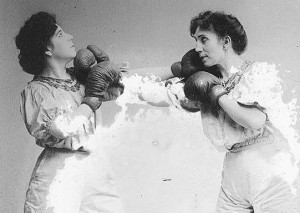
Differences of opinion arise and may result in conflict.  However, Christians bickering with one another provide a poor example of Christ's love for the world.  The Apostle Paul was made aware of conflict within the church at Philippi.  He addresses the issue.
Therefore, my brethren dearly beloved and longed for, my joy and crown, so stand fast in the Lord, my dearly beloved.
I beseech Euodias, and beseech Syntyche, that they be of the same mind in the Lord.
And I intreat thee also, true yokefellow, help those women which laboured with me in the gospel, with Clement also, and with other my fellowlabourers, whose names are in the book of life.
Rejoice in the Lord always: and again I say, Rejoice.  --Philippians 4:1-4 (KJV)
There is no hint as to the conflict between Syntyche and Euodias but we know it was creating a problem within the church.  Paul says, "Please!  Unity in Christ Jesus!"   Whether the dispute was between these two women differing with one another or, as some have suggested, these two women creating turmoil by disagreement with church polity or policy we are, again, uncertain.  What we do know is that Euodias and Syntyche were leaders, perhaps even ordained in the church.  Their voices and their examples bore weight within the community.  Paul pleads for unity and he asks for help of those who are yoked together with him in Christ in resolving the differences posed by these strong women in the church.

No less should we be careful, no matter how our opinions might differ, to present a united front in the presentation of the true gospel, the love of God and Christ crucified for the remission of our sins, eschewing conflicts, no matter how minor, which might hinder the work with which we are charged!
Now the God of peace be with you all. Amen. --Romans 15:33 (KJV)
 http://comefillyourcup.com/wp-content/uploads/2012/06/Sisters-boxing-cropped-300x213.jpg
Image from Comefillyourcup,com

Sunday, September 3, 2017

Five Metaphors

The Book of Jude, short but powerful, admonishes the Church to beware of false teachers, using these metaphors found in verses thirteen and fourteen to characterize these charlatans and pretenders.

These are spots in your feasts of charity, when they feast with you, feeding themselves without fear: clouds they are without water, carried about of winds; trees whose fruit withers, without fruit, twice dead, plucked up by the roots;

Raging waves of the sea, foaming out their own shame; wandering stars, to whom is reserved the blackness of darkness for ever.

1.  "These are spots in your feasts."  False teachers are blemishes, partaking to themselves but contributing nothing.

2. They are "clouds without water, carried about of winds."  False teachers drift like clouds above a semiarid land, holding out the promise of rain, but containing no water.  They are blown about by capricious winds, providing nothing.

3. They are "trees whose fruit withers."  A tree that bears no fruit is useless, dead; and these are twice-dead, for they have been uprooted from truth.

4.  They are "raging waves of the sea, foaming out their own shame."  Picture the wind-blown waves dashing against the walls of stone along the shore, the spray flying every which way, accomplishing only the erosion of the rocks.  Such is the effect of false teachers on the body of believers.

5, False teachers are "wandering stars, to whom is reserved the blackness of darkness forever."  Travelers in the desert or on the seas may use a fixed star, e.g., the Pole Star for guidance.  But to rely on a heavenly body whose position varies with the motions of the celestial realm is to be misled, lost.  To rely on such teachers is to be lost. Note, too, the fate of such "stars."
 It is imperative that we check any teaching within the Church against  the navigational chart given us by God, that is The Holy Bible.  All teachings must be supported by scripture, else we will be led astray.

Sunday, April 16, 2017

Resurrection Sunday!


"He isn't here! HE is risen from the dead, just as He said would happen." -Matthew


"The resurrection tidings are far and away the most astonishing news to ever break across the tired, old face of this earth." -Gardner C. Taylor

" The Easter resurrection is the ultimate reason why failure and crosses need not intimidate us." -Ed Hird

"It is hard to imagine anything less hopeful than the sight of a burial. When the body of Christ was taken down from the cross, wrapped in a clean linen cloth and laid in a new tomb hewn out of the rock, how many who looked on had the faith to hope that inside three days this dead Man would be walking again among men and women, alive forevermore? But so it came to pass. Aaron's rod budded. The leafless tree on which the Savior died sprang into bloom. What had been stark death before became life at the touch of God, and the gallows became the gate to everlasting life.

"One thing the resurrection teaches us is that we must not trust appearances. The leafless tree says by its appearance that there will be no second spring. The body in Joseph's new tomb appears to signify the end of everything for Christ and His disciples. The limp form of a newly-dead believer suggests everlasting defeat. Yet how wrong are all these appearances. The tree will bloom again. Christ arose the third day according to the Scriptures, and the Christian will rise at the shout of the Lord and the voice of the archangel.

"Faith can afford to accept the appearance of defeat, knowing the true believer cannot be defeated finally. 'Because I live, you also will live.' That is the message of Easter. What a blessed message for the whole world if men would only believe it." -Aiden Wilson Tozer


He died that you might be saved. He arose that you might live with Him eternally!

Happy Easter!

Pedro, Juan y Maria Magdalen en el sepulcro vacio
Jaime Dominguez Montes

Sunday, April 2, 2017

Read the Old Testament

On last Sunday's post, this comment: 
Once again, I puzzle with how to apply OT stories to present day circumstances. But if Brother desires to bestow wealth upon me, I won't worry about application.

I responded:

The application here is simply follow God's lead. Of course, if you wish to share your wealth with your elder brother, that is good, too

 In the wee hours  I became aware of the fact that my answer needs expansion. so this:

It seems to me that the Old Testament provides example after example of the necessity to pursue the will of God.  Those who follow God's leading seem to bask in His approbation.  Those who fail to do so apparently fall into disfavor such that the end results are not pretty.

Beginning in the Garden of Eden we see the forebears, given one simple prohibition, unable or unwilling to abide by the strictures, plunge the entire human race into chaos.

We see Noah accomplish a daunting, even seemingly impossible task.  He is rewarded with life.

Moses rose to worldly prominence, sank to level of murderer and exiled himself from the land, yet at the age of eighty when God called him, he responded.

Saul defies the rules of the Lord and loses everything, including his life.

David is highly favored of the Lord, yet the desire of his life is not granted because of the sin he allowed to creep in..

And so on.


The point that I hope to make is two-fold.  To read the Old Testament is to read the Bible as Jesus knew it, for the OT was the Bible from which he worked and which he often quoted in his ministry.  To read the Bible is not only instructive in the necessity of seeking God's purpose for our lives, it is also laden with fascinating accounts of man's struggles, his relationships with his fellow-man, and his interaction with God.
 
A dear old lady, now deceased, told me she did not like the Old Testament, it is "so bloody," she said.  I submit that whatever blood was shed in the Old Testament was as nothing to the shedding of the blood of our Lord and Savior, Jesus Christ, the blood that is necessary and sufficient for our salvation.
 
"What can wash away my sin? Nothing but the blood of Jesus."  --Robert Lowry

Sunday, February 5, 2017

Attention to Detail

The Books  of  the Kings (1 Samuel, 2 Samuel, 1 Kings, 2 Kings)* are very interesting reading, if sometimes tough  sledding.  There  are many stories, some  brief, some that require extrapolation  in  order  to mine a nugget  therefrom.  Some are  bloody, some illustrative of the rewards of  righteousness as well  as the punishments of  evil.

Today look for a bit at the fifteenth chapter of 2 Kings in which Azariah comes to the Judean throne in Jerusalem.  He was sixteen years of age when he began his reign.  Azariah was the son of Amaziah and Jecholiah.  This reference to his mother is the only place in the Bible where she is named.  The significance of the recognition perhaps lies in the fact that her name means "powerful."  Combine that with the father's name which some scholars believe means "strong" and imagine a son from that union.

Azariah, or Uzziah as he was also called, he being the same Uzziah that Isaiah referred to in the introduction to the Book of Isaiah, ruled for fifty-two years.  The good news is that he "did that which was right in the sight of the Lord" as his father before him had done.  The bad news is that notwithstanding the good he did, he failed in one point: he did not eliminate the burning of sacrifices and incense in "high places."  These "high places" were forbidden to the children of God as they were basically places of sex-oriented idol worship.  They remained popular with the people.  And.

And "God smote the king, that he was a leper" the rest of his life.  No time frame is given, so we cannot know how long he was so afflicted, yet he did live sixty-eight years.  He lived in what we would call quarantine, no doubt within the palace, and his son, Jotham, carried out the duties of judging the people.

From this example one might extrapolate that it is possible to live according to God's plan and yet neglect one small area that needs to be tended to.  And.

And I think that is not inaccurate.
 Finally, brethren, whatsoever things are true, whatsoever things are honest, whatsoever things are just, whatsoever things are pure, whatsoever things are lovely, whatsoever things are of good report; if there be any virtue, and if there be any praise, think on these things.  --Philippians 4:8 (KJV)
*The Chronicles of  the  Kings relate to the reigns  of the same monarchs that  are recorded in the Books of the  Kings.  The principal difference is that the Kings record historical  data and actions of the people involved; Chronicles provides  interpretations of  the acts.

Word of the day: extrapolate

Saturday, December 17, 2016

Xmas and Related Things

Seriously.  I was thinking of writing a post about some of the elements in the "Christmas Wars" and while I pondered, stewing in my own juices somewhat, I started surfing through my blog roll as I hadn't checked on some of my friends in a few days.

I found this at KCBob's and he has done a much better job than I might have done.  I recommend this *click* to you.

You are welcome.

Sunday, December 4, 2016

Second Sunday of Advent 2016

  • In this season of Advent it is meet and right that we should reflect on the coming of the Christ in flesh to mingle with mankind and to lay down His life for our salvation.  But it is imperative that we think, too, on the Advent when Christ shall return to Earth as conqueror and king, gathering His faithful to rule with Him.

Collect for the Season (from Boston's Church of the Advent)
Almighty God, give us grace that we may cast away the works of darkness, and put upon us the armor of light, now in the time of this mortal life in which thy Son Jesus Christ came to visit us in great humility; that in the last day, when he shall come again in his glorious majesty to judge both the quick and the dead, we may rise to the life immortal; through him who liveth and reigneth with thee and the Holy Ghost, one God, now and for ever. Amen.
Related image

Sunday, October 30, 2016

Jesus and the Pharisees

In Matthew chapter eleven we find Jesus again in conflict with the religious leaders of his time.  Listen to Him:

"To what can I compare this generation? They are like children sitting in the marketplaces and calling out to others:
 We played the pipe for you,
    and you did not dance;
we sang a dirge,
    and you did not mourn. " (Matthew 11:17,18)

These children playing these tunes are the Pharisees and scribes.

They are playing the pipe to which John will not dance, eschewing a life of ease for the desert experiences.  They are playing the dirge, for Jesus lives a life style which they perceive to be in violation of the law.  By the law they mean not the ten commandments, but the entire body of "law" as developed over the centuries by the religious leaders.

With these hyper-religious fanatics the only way to "win" is to toe the line they draw.  Yet John did not dance, nor did Jesus mourn.

This chapter ends with these words of the Master:

"Come to me, all you who are weary and burdened, and I will give you rest. Take my yoke upon you and learn from me, for I am gentle and humble in heart, and you will find rest for your souls. For my yoke is easy and my burden is light.”  (Matthew 11:28-30)

Bible quotes from the NIV.

Some commentators suggest that Jesus in quoting the verse about the children playing is borrowing from Aesop's fable of the fisherman piping.

Thursday, October 27, 2016

Mt. Carmel Community Church #T

I was working at the back of the platform in the sanctuary.  Seems the term "stage" would be more applicable since the transformation of the entire space four years ago.  Piano, organ, pulpit, lectern, altar rails all removed.  Pews removed and replaced with cushioned chairs and so on.  But on with the story.

I had my bottle of window cleaner and a soft towel quietly contemplating the elements of worship as I cleaned the enclosure surrounding the drum set.  Pity the percussion instruments are not completely surrounded with sound-proof glass, but again I digress.  The area at the back of the room brightened as someone opened the front door.  I looked in that direction.  A woman clad in a yellow knee-length dress with full skirt and a red bolero-style sweater stepped in and glanced around.  It was evident that she did not see me as she went directly to the "missions" box that sat on a table to the left of the  door.

The woman picked up the box, glanced around the sanctuary again, then she set the box down.  The lid was fastened with a hasp, but there was no lock so she simply opened the lid and reached inside.  I could see that she had several bills in her hand as she open the purse that was slung from her left shoulder.  But she dropped the money back into the box, removed the purse from her shoulder and set it on the table.  I took a step toward the front of the platform and she quickly looked up and toward  me but she seemed not to see me.  This small, thin, brightly clad being then took the offering box in both hands and dumped its contents into her purse.

By this time I was near the steps at the front of the stage and as she was zipping her tote I said, in my best stentorian manner, "Bless you, my child!"

Startled?  I thought she would surely break for the door but she was so startled that she was frozen in place.  As she looked at me her eyes and her mouth were as though they were three gaping caverns.  Her face was so thin that the rest of it seemed to disappear,

When I was ten feet from her I stopped.  Black hair, black eyes, olive complexion.  As she closed her mouth I could see the creases  in her forehead and the age lines around her mouth.  She wore  white sneakers, not the spike heels of someone out on the town.  This was not a young person.  I've no idea of the burdens of life that may have caused the creases and wrinkles and I normally do not try to guess ages by appearances, but I am guessing that the person I was confronting was late fifties, perhaps even early sixties.

"Tiena usted Ingles?"  I asked.

"S-si, uh, yes."  As she was unzipping her bag she continued.  "Look, sir, I am putting it back."

"No!  Listen to me."  She looked at me.  "Listen.  Take the money home and count it carefully.  Write down the amount on a piece of paper."

"That is hard.  I keep four nietos.   Grandchildren.  You understand?"

"Look at me.  What is your name?"

Glancing quickly at the wall opposite then meeting my eyes she said, "Carmel.  Carmelita."  On the wall was a banner which proclaimed "WELCOME TO MT. CARMEL COMMUNITY CHURCH."

"Listen. Carmelita.  Write down the amount.  Next time you are in the neighborhood drop that paper into the box, okay?  I will make up the amount in the missions box. Go."

Purse strap over her shoulder, she turned to go.  "Gracias,  Señor."

"Vaya con Dios."

That's the end of that, I thought.

Two weeks later on impulse I looked into the offering box.  There was a folded scrap of paper.  On the inside was written in pencil "2642$."

I surely hope there is supposed to be a decimal point between the six and the four.

Epilogue

The next Sunday just before the drummer tapped the rhythm for the first number on the rim, the sanctuary door opened and a certain small, sixtyish lady, clad in red and yellow, walked in, followed by four children ages probably five to twelve.

©2016 David W. Lacy


Wednesday, October 19, 2016

"I Received My Sight!"

Then the neighbors, and the ones seeing him formerly— because[c] he was a beggar— were saying “Is not this the one sitting and begging?” Others were saying that “This is he”. Others were saying, “No, but he is like him”. That one was saying that “I am he”. 10 So they were saying to him, “How then were your eyes opened?” 11 That one answered, “The man being called Jesus made mud and smeared it on my eyes, and said to me ‘Go to Siloam and wash’. So having gone away and washed, I received-sight”. 12 And they said to him, “Where is that One?” He says, “I do not know”.  John 9:8-12 (DLNT)

Now this one who was doubtless a familiar figure to many because he regularly sat in a public place begging presents himself seeing and the people are astonished.  Astonished, but divided.  Some said, "Verily this is he who was blind, and now he sees." 

 Others, less prone to believe, or we might say the more skeptical, saw the man but they saw a doppelganger, "Nay, it is some stranger who merely looks like our familiar beggar."

The man now avers, "I am he; the very man, the blind one, you have passed by for years."

"So then how is it that you see?"

"The man called Jesus," he replied, "daubed my eyes with mud, told me to wash in Siloam, which I did, my eyes were opened and now I see!"

Note the testimony.  "I did as Jesus told me to do, then I saw."  Have you done as Jesus told you to do? 

This, of course, is not the end of the story.  The Pharisees get involved and call the former blind man to account.  He gives his testimony.   Then someone observes that it is the Sabbath.  Surely for One to perform such a miracle is a violation of the Sabbath Laws.


16 Then some of the Pharisees were saying, “This man is not from God, because He does not keep the Sabbath”. But others were saying, “How is a sinful man able to do such signs?”  (DLNT)


Division amongst the religious leaders.  Now begins the turmoil.  "Who do you say this man is?" they asked the recipient of the miracle.  "He is a prophet," he replied.

This will not do.  The Pharisees call the man's parents to testify.  Yes, he is our son.  Yes, he was born blind.  But for fear of being cast from the congregation they dared not confess that Jesus is the Christ. They said, We have no idea who the man is.  Ask our son; he is of age.  He can speak for himself.

So they called this man, this now-harassed man, yet again and posed their questions yet again.


27 He answered them, “I told you already and you did not listen. Why do you want to hear it again? You also do not want to become His disciples, do you?”  

28 And they reviled him and said, “You are a disciple of that One, but we are disciples of Moses. 29 We know that God has spoken to Moses. But we do not know where this One is from”. 

30 The man responded and said to them, “Why, in this is the marvel— that you do not know where He is from, and He opened my eyes! 31 We know that God does not hear sinners. But if anyone is a God-fearing one, and is doing His will— He hears this one. 32 It was not ever heard that someone opened the eyes of one having been born blind. 33 If this One were not from God, He would be able to do nothing”. But if anyone is a God-fearing one, and is doing His will— He hears this one.”  (DLNT)

Our subject, knowing that he was blind and now he sees, is clearly convinced that his benefactor is the Christ and makes bold to challenge the religious teachers and proclaims, "We know that God does not hear sinners. But if anyone is a God-fearing one, and is doing His will— He hears this one.  It was not ever heard that someone opened the eyes of one having been born blind.  If this One were not from God, He would be able to do nothing”.

This is interesting because the man, though having been blind and a beggar, is skilled in disputation, for he uses the time-honored technique of binding himself and his  opponents together by use of the "we know" phrase which they themselves had used.  Not only do you know this to be true, but now you know that I know it as well, hence my words are true.  Teachers and mathematicians and genealogists use this to this day.  In effect, If you don't know it, believe me, because I know what I am saying.

Further the Pharisees are challenged to become Jesus's followers as well.  The response to which is the casting of the messenger from their midst.  Those convinced against their will are of the same opinion still.          TBC


Sunday, October 2, 2016

Be of Good Courage

 Whither shall we go up? our brethren have discouraged our heart, saying, The people is greater and taller than we; the cities are great and walled up to heaven; and moreover we have seen the sons of the Anakims there.  Deuteronomy 1:28 (KJV)

After forty years in the wilderness the people arrive at the edge of the Promised Land.  They send a committee over to assess the situation.  The report: It is a good and fruitful place, but the people are huge; we are as grasshoppers in their sight.  So they are moaning as we read in this verse.

Our brethren have discouraged our heart.

How much does this sound like Christians today, Christians who have been commissioned to preach the Good News of Jesus Christ?  Oh, Dear (hand wringing) the sky is falling!

The Lord commanded His People to take the land and promised to go with them.

Today, the Lord commands our service in the proclamation of the gospel, and He promised to go with us.

Yes, the obstacles are huge but they are as nothing in the sight of our God.

As Moses said to Joshua, and as Joshua said to The People, "Be of good courage."


Sunday, September 11, 2016

Worth Thinking About


" It seemed good to me also, having had perfect understanding of all things from the very first, to write unto thee in order, most excellent Theophilus, that thou mightest know the certainty of those things, wherein thou hast been instructed."  Luke 1:3,4


"The former treatise have I made, O Theophilus, of all that Jesus began both to do and teach. . ."   Acts 1:1

Luke addresses both his Gospel and the Acts of the Apostles to a "Theophilus."

Scholars have speculated about Theophilus.  Who was he?  What is his background?  What was his relationship to Luke?  And so on.

Sometimes, and you draw your own conclusions, the simplest explanation for an enigma is the correct explanation.  It occurs to me that in the Greek "Theophilos" means "Friend of God."

Thus Luke addresses his writings to those who are friends of God-- to you and to me if we have surrendered our will to God's will.

Sunday, September 4, 2016

If God be for us who can be against us?

"And ye murmured in your tents, and said, Because the Lord hated us, he hath brought us forth out of the land of Egypt, to deliver us into the hand of the Amorites, to destroy us.

"Whither shall we go up? our brethren have discouraged our heart, saying, The people is greater and taller than we; the cities are great and walled up to heaven; and moreover we have seen the sons of the Anakims there."  --Deuteronomy 1:27,28

The Israelites had wandered in the wilderness forty years and now the people are directed to take the land which the Lord their God had promised to their fathers.  And we hear this response.

Many times God's people are led into situations where trust in God and forging ahead is the correct response, and yet the task seems impossible.  Of course it is impossible in our human strength, but with God on our side it must be accomplished!

Oh, but the sons of the Anakim are in the land.  We've no chance against such a foe.  And again, we today face assignments that are daunting or difficulties that seem insurmountable.  And of course they are in our own strength.  But God is on our side.  He will neither leave us nor forsake us.  If it is God's will we will overcome.  Invest your trust in the Maker and Master of the Universe!

When God gives you a mission, He will equip you for the task.

Sunday, August 14, 2016

Faith, Trust, and Service

Today's lesson is found in the seventeenth chapter of Luke's Gospel in which we observe the disciples coming to Jesus with a request:
    
The apostles came up and said to the Master, “Give us more faith.”
But the Master said, “You don’t need more faith. There is no ‘more’ or ‘less’ in faith. If you have a bare kernel of faith, say the size of a poppy seed, you could say to this sycamore tree, ‘Go jump in the lake,’ and it would do it.
7-10 “Suppose one of you has a servant who comes in from plowing the field or tending the sheep. Would you take his coat, set the table, and say, ‘Sit down and eat’? Wouldn’t you be more likely to say, ‘Prepare dinner; change your clothes and wait table for me until I’ve finished my coffee; then go to the kitchen and have your supper’? Does the servant get special thanks for doing what’s expected of him? It’s the same with you. When you’ve done everything expected of you, be matter-of-fact and say, ‘The work is done. What we were told to do, we did.’”  (Luke 17:5-10, The Message)
 This is a striking teaching on faith.  Faith, according to Jesus, is not quantified.  Either one has faith or he does not.  Thus to say, "I wish I had more faith," is to say, "I have no faith."  It is imperative that we rely on God and trust in His perfect will.

Jesus further teaches us our role in the service of the Kingdom by using the human master/servant relationship as a model.  The servant coming in from his daily toil does not expect to be treated as a guest in the household, but rather knows that he may well be required to provide further service to the master.  He fulfills his duties and is rewarded with his sustenance.  And the service of disciples is just the same.  We are to finish the work so that we may report to the Master, "We have done as we were told."  Our  reward is fulfillment of our needs.  True to His promise, He will provide.  We accept in gratitude, whether or not we get a pat on the head.

In the words of the old hymn, "Oh, for faith to trust Him more."

Sunday, August 7, 2016

The Law of Faith

 These are observations of my father, Rev. Mr. D. W. Lacy, 1911 - 1999

The Genesis gives a complete record of Our Lord’s preparation of his intent to make man. Call this paternal preparation a masterpiece of Holy origin.  Christians owe it to themselves to read carefully the record of beginnings as revealed to us by the Lord, our Sovereign Savior.

Approximately 4000 years after the record of God’s paternal preparation for the reign of man we find light in The Gospel of John 2:9 concerning THE WORD.

He is presented as God, as executive agent in the creation of all things as presented in the Genesis record.  Christ was there in the beginning as Creator and will be there in the final great assize.

The Garden of Eden was the handiwork of God, a nursery of preparation.   Nothing was omitted. [There was] complete coverage of all things necessary for comfort and growth.  The only guidance [man] had in the occupancy of the Garden was an invisible Key known as the Law of Faith.  Nothing was under material lock.  The Lord put Adam and Eve into their new home with these words,  “Dress and Keep it.” (Genesis 2:15)  That was an unwritten law.  There was an exception and commandment that says their welfare was under the canopy of Divine authority and protection.  “You are not to eat of the Tree of Knowledge of good and evil."  A reasonable relationship.  Adam and Eve understood, having the image of God’s Spirit encoded in the brain and boundaries defined.  We must understand that the Garden was an open one in which God came (Genesis 3:8), and the Serpent came also.

Adam was endowed with responsibility, transcending intelligence and wisdom, and the law of faith contained the complete essence of God’s intent and Adam’s understanding:  a constitutional awareness and rapport between them.

©2005 David W. Lacy