February 10 is the Feast Day of St. Scholastica. Scholastica was the twin sister of St. Benedict, well-known as the founder of the Benedictine order. The lady, in her service to God, founded a nunnery near Benedict's monastery.1 While neither could visit the other on the site of their residences, they met once a year at a neutral site for prayers and conversation. Scholastica died a few days after one of these annual visits, and it is said that Benedict in a vision saw her soul ascend into heaven. He brought her body to the monastery for interment in the tomb he had constructed for himself.2
St. Scholastica died in 543. Now fast-forward 812 years. In Oxford, England on the saint's feast day, two students from university got into a dispute with an innkeeper over the quality of the drinks, continuing to the tossing of said drinks into the barkeep's face. The immediate result of this contretemps was the death over a period of two days of more than ninety people of whom two-thirds were students. The end was not to be seen for yet another 600 years. Events went briefly as follows:
The resolution in favor of the university required the mayor and councillors of the town to march bareheaded through the streets on St. Scholastica's Day each year and pay to the university a penny for each student who lost his life in the riots. This continued until 1825 when the mayor refused to participate.
Finally, the matter was resolved when, on February 10, 1955, an act of conciliation saw the Mayor awarded an honorary degree from University, and the Vice-Chancellor was made an Honorary Freeman.3
Long memories, those Brits.
1I first typed "monkery" which is what I have long thought the places should be called, but spell-check objected to the usage.
2Catholic Online
3Wikipedia
Showing posts with label Britain. Show all posts
Showing posts with label Britain. Show all posts
Monday, February 10, 2014

Thursday, August 22, 2013
Charles I Challenges Parliament #T
It was on August 22, 1642 that King Charles I unfurled the royal standard at Nottingham Castle.
This signalled the beginning of the civil war between Parliament and the Throne.
Charles had been blessed, or at least impressed, with the notion of "Divine Right of Kings," the which concept is credited to his father, James I. The British peoples had a historically long-standing notion of independence and self-governance. The clash of these concepts inevitably led to serious difficulties. One might in fact say that the king lost his head over the whole contretemps he initiated.*
I have been reading Rebecca Fraser's The Story of Britain, an entertaining 800 pages of information with which I suppose I should have been familiar, but much of which seems to be new to me. I do not read English history because I am an Anglophile, but rather because, as is the case with world history in general, it sheds light on the entire enigma of how we got to be who we are.
It is my opinion that our young people would be well-served should our educational system return to greater emphasis on history and less perhaps on ego-inflating exercises that tend to encourage excessive emphasis on self-image and the entitlement mindset which accompanies it. We have for a generation now wrung our hands over our "place in the world" vis a vis science and mathematics education. These are valid areas of concern, and these are important subjects, but we must never barter our humanity in exchange for technology.
This started out to be a post about King Charles I and a brief period in the middle of seventeenth century English history. Oh, well. You have become somewhat familiar with my penchant for going down rabbit trails.
*"The death warrant was signed by only 59 of the 135 commissioners. The rest had slunk away, reluctant to set their names to a document of such dubious legality. Thus Charles I was condemned to death by a minority of the court, which had been established by a minority of the House of Commons, indeed by an illegal remnant thereof, and without the concurrence of the House of Lords." Fraser, Rebecca: The Story of Britain, p.349. She continues, "Death transformed the foolish, treacherous king into a martyr. . .", p. 350
That Charles himself might chase
To Carisbrooke's narrow case:
That then the royal actor born
The tragic scaffold might adorn:
While round the armèd bands
Did clap their bloody hands.
He nothing common did or mean
Upon that memorable scene:
But with his keener eye
The axe's edge did try:
Nor called the gods with vulgar spite
To vindicate his helpless right,
But bowed his comely head,
Down, as upon a bed. --from "Cromwell's Return" by Andrew Marvell
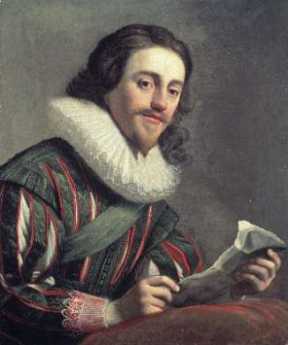
Charles I 1600 - 1649
This signalled the beginning of the civil war between Parliament and the Throne.
Charles had been blessed, or at least impressed, with the notion of "Divine Right of Kings," the which concept is credited to his father, James I. The British peoples had a historically long-standing notion of independence and self-governance. The clash of these concepts inevitably led to serious difficulties. One might in fact say that the king lost his head over the whole contretemps he initiated.*
I have been reading Rebecca Fraser's The Story of Britain, an entertaining 800 pages of information with which I suppose I should have been familiar, but much of which seems to be new to me. I do not read English history because I am an Anglophile, but rather because, as is the case with world history in general, it sheds light on the entire enigma of how we got to be who we are.
It is my opinion that our young people would be well-served should our educational system return to greater emphasis on history and less perhaps on ego-inflating exercises that tend to encourage excessive emphasis on self-image and the entitlement mindset which accompanies it. We have for a generation now wrung our hands over our "place in the world" vis a vis science and mathematics education. These are valid areas of concern, and these are important subjects, but we must never barter our humanity in exchange for technology.
This started out to be a post about King Charles I and a brief period in the middle of seventeenth century English history. Oh, well. You have become somewhat familiar with my penchant for going down rabbit trails.
*"The death warrant was signed by only 59 of the 135 commissioners. The rest had slunk away, reluctant to set their names to a document of such dubious legality. Thus Charles I was condemned to death by a minority of the court, which had been established by a minority of the House of Commons, indeed by an illegal remnant thereof, and without the concurrence of the House of Lords." Fraser, Rebecca: The Story of Britain, p.349. She continues, "Death transformed the foolish, treacherous king into a martyr. . .", p. 350
That Charles himself might chase
To Carisbrooke's narrow case:
That then the royal actor born
The tragic scaffold might adorn:
While round the armèd bands
Did clap their bloody hands.
He nothing common did or mean
Upon that memorable scene:
But with his keener eye
The axe's edge did try:
Nor called the gods with vulgar spite
To vindicate his helpless right,
But bowed his comely head,
Down, as upon a bed. --from "Cromwell's Return" by Andrew Marvell
Charles I 1600 - 1649
Subscribe to:
Posts (Atom)